

“How long will it take?” It’s the first question every homeowner asks when considering an extension, and the honest answer is that it depends. But that’s not particularly helpful when you’re trying to plan around work, school holidays, or simply manage expectations about how long your home will be a building site.
So let’s give you a proper answer.
A typical single-storey rear extension takes 10-14 weeks to construct, or 4-6 months from initial consultation to completion. This will include the design, planning approvals, and preparation time.
But what actually happens during those weeks? What should you expect to see when you come home each day? And how do you know if your project is progressing normally?
In this guide, we’re sharing the complete house extension building process stage by stage, week by week, illustrated with real photographs from a project we completed in Marks Tey, Essex. No stock images, no vague timelines. Just an honest look at how extensions are actually built, from the first dig to the final handover.
Whether you’re about to start a project or still weighing up your options, understanding the build process helps you plan effectively and know what to expect.
How Long Does A House Extension Take?
Before we dive into the detail, here’s the headline summary. These timelines represent typical projects, however, each project is unique and your extension may vary depending on complexity, site conditions, and specification.
| Extension Type | Design & Approvals | Construction Phase | Total Project Time |
| Single-storey rear extension | 4-8 weeks | 10-14 weeks | 4-6 months |
| Double-storey extension | 6-12 weeks | 14-20 weeks | 5-8 months |
| Wrap-around extension | 6-10 weeks | 12-16 weeks | 5-7 months |
| Large/complex extension | 8-16 weeks | 20-30 weeks | 7-12 months |
Important distinction: The “construction phase” is the time your builder is on site. The “total project time” includes everything from your first meeting with an architect or builder through to completion.
Many homeowners underestimate the pre-construction phase. Designing, obtaining approvals, getting quotes, and ordering materials all take time, but this preparation is what allows the construction phase to run smoothly.
The 10 Stages of Building a House Extension
Every house extension follows the same core stages, regardless of size or complexity. Here’s a quick overview of what to expect during the construction phase:
- Site Setup & Preliminary Works: Equipment arrives, existing structures are removed, and the site is prepared and secured for construction.
- Groundworks & Foundations: Trenches are excavated, foundations are poured, drainage is installed, and blockwork is built up to damp-proof course level.
- Brickwork & Blockwork: The walls of your extension rise course by course, with cavity insulation, lintels, and wall ties fitted as they go.
- Structural Carpentry: Carpenters install the roof structure, floor joists, and internal timber framing.
- Roof Coverings: Breathable membrane, battens, tiles, lead work, and guttering are fitted to make the roof weatherproof.
- Windows, Doors & Making Watertight: Glazing and external doors are installed, fully enclosing the structure against the elements.
- First Fix: All hidden infrastructure is installed behind the walls: electrical cables, plumbing pipes, insulation, and floor screed.
- Plastering & Internal Finishes: Plasterboard is fitted and skim-coated to create smooth, finished walls and ceilings.
- Second Fix & Installations: All visible fittings are connected: sockets, lights, kitchen, bathroom, flooring, doors, and skirting.
- Snagging, Finals & Handover: Final inspections, corrections, Building Control sign-off, and handover of your completed extension.
Each stage is covered in detail below with real photographs from one of our Essex projects.
Before Construction Begins: The Pre-Build Phase
Before any diggers arrive, several things need to happen. This pre-construction phase varies significantly depending on your project, but here’s what to expect.
Design and Planning (2-8 weeks)
Working with an architect, architectural technician, or your builder’s design team, you’ll develop detailed drawings that show exactly what will be built. This includes floor plans, elevations, and construction details.
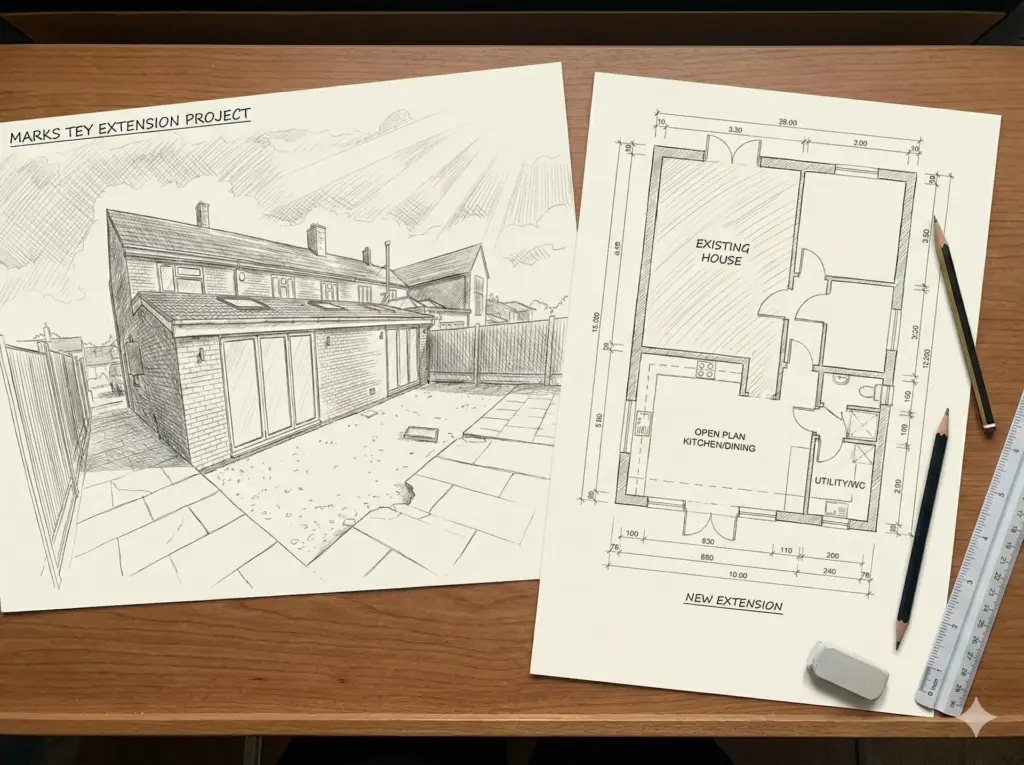
The more complex your extension, the longer this takes. A straightforward rear extension might need just a few weeks; a whole-house remodel could take months to get right.
Our advice: Don’t rush this phase. Changes are easy and cheap on paper, they’re expensive and time-consuming once construction begins.
Planning Permission and Building Regulations (2-12 weeks)
Many extensions fall under Permitted Development rights, meaning you can build without a full planning application. However, you’ll still need Building Regulations approval, which ensures your extension is structurally sound, energy efficient, and safe.
- Permitted Development: No planning application needed, but you may want a Lawful Development Certificate for peace of mind (typically 4-6 weeks)
- Full Planning Permission: Required for larger extensions or those in conservation areas (typically 8-12 weeks)
- Building Regulations: Always required; approval typically takes 2-4 weeks
[Related: Do I Need Planning Permission for a House Extension in Essex?]
Party Wall Agreements (2-8 weeks if required)
If your extension is built on or near a shared boundary with neighbours, you’ll likely need a Party Wall Agreement under the Party Wall Act. This is a legal process that protects both you and your neighbours.
If your neighbours consent quickly, this can be resolved in a couple of weeks. If they dispute or simply don’t respond, it can add two months or more to your timeline.
Tip: Talk to your neighbours early. Explain your plans, show them the drawings, and address any concerns before serving formal notices.
Appointing Your Builder and Lead Times (2-4 weeks)
Good builders are busy. You may need to wait several weeks, or even months, for your preferred contractor to become available.
Your builder will be responsible for ordering and scheduling the bulk of materials into the build programme, including structural steelwork, windows, doors, and roof lights. These are timed to arrive exactly when they’re needed on site, so you don’t need to worry about coordinating them.
However, you’ll typically be responsible for ordering your own:
- Kitchen units and worktops (4-8 weeks lead time)
- Sanitary goods (toilets, sinks, taps, showers) (2-6 weeks)
- Tiles and flooring (2-4 weeks)
Your builder should guide you on when to place these orders so everything arrives at the right stage.
If you’re bringing in any external trades such as solar panel installers, security system companies, or family trades for specific areas let your builder know early. A good contractor will take their details and coordinate directly to avoid delays or miscommunication.
The 10 Stages of Building a House Extension
Once all the preparation is complete and your builder is ready to start, the construction phase begins. Here’s what happens at each stage, with photographs from a recent single-storey extension project in Marks Tey, Essex.
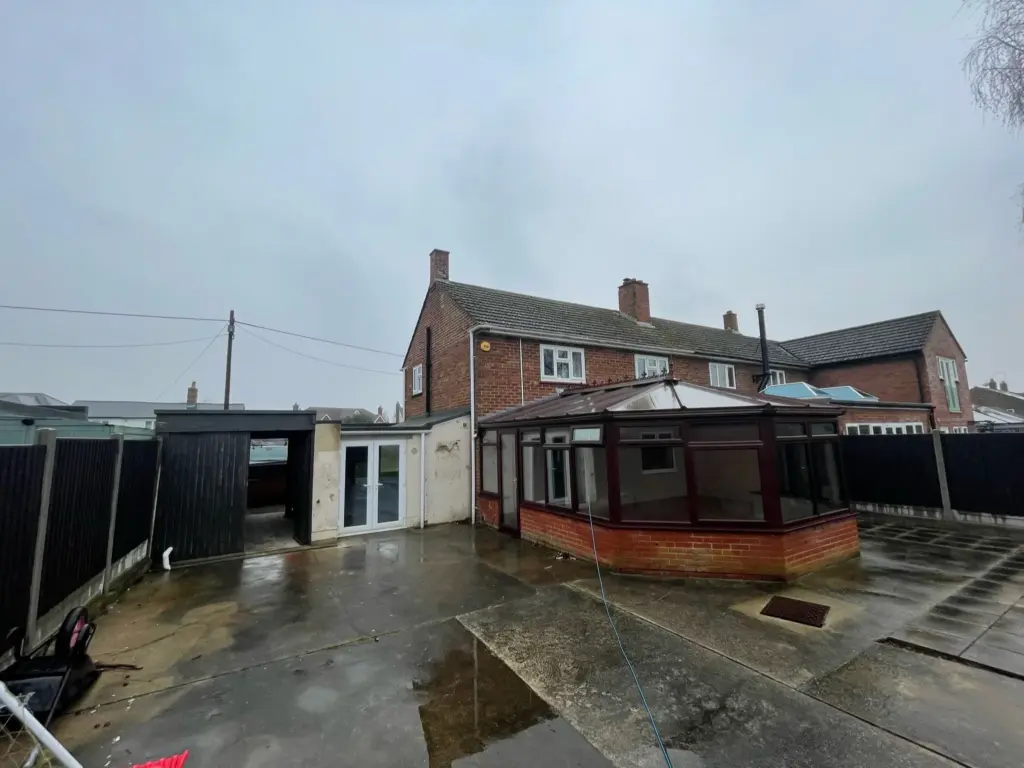
Stage 1: Site Setup and Preliminary Works
Timeline: Week 1 What’s happening: Preparing the site for construction to begin
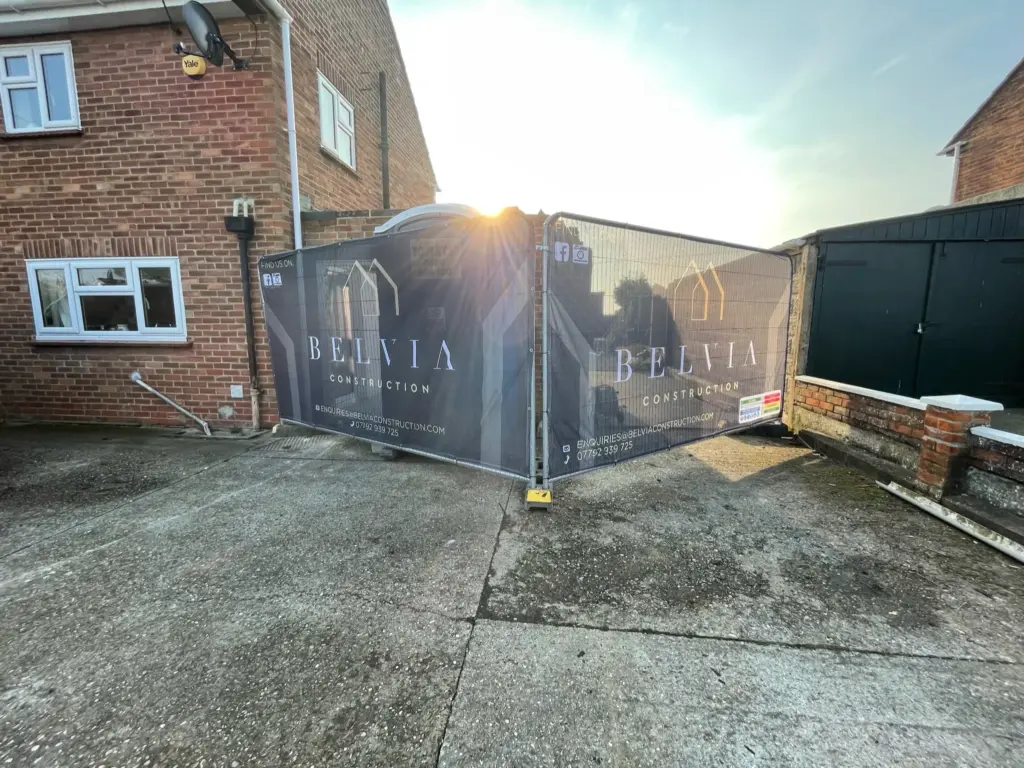
Before any building work starts, we need to establish the site. This isn’t the most exciting phase, but it’s essential groundwork (literally) for everything that follows.
What happens during this stage:
- Equipment and plant arrive – Diggers, mixers, and tools are delivered to site
- Site security and welfare – Temporary fencing, secure storage for materials, and welfare facilities for the team
- Enabling works – Initial removals, demolition of any existing structures, and strip-out work to prepare the area
- Protection measures – We’ll protect your garden, establish access routes, and agree where materials will be stored
What you’ll see:
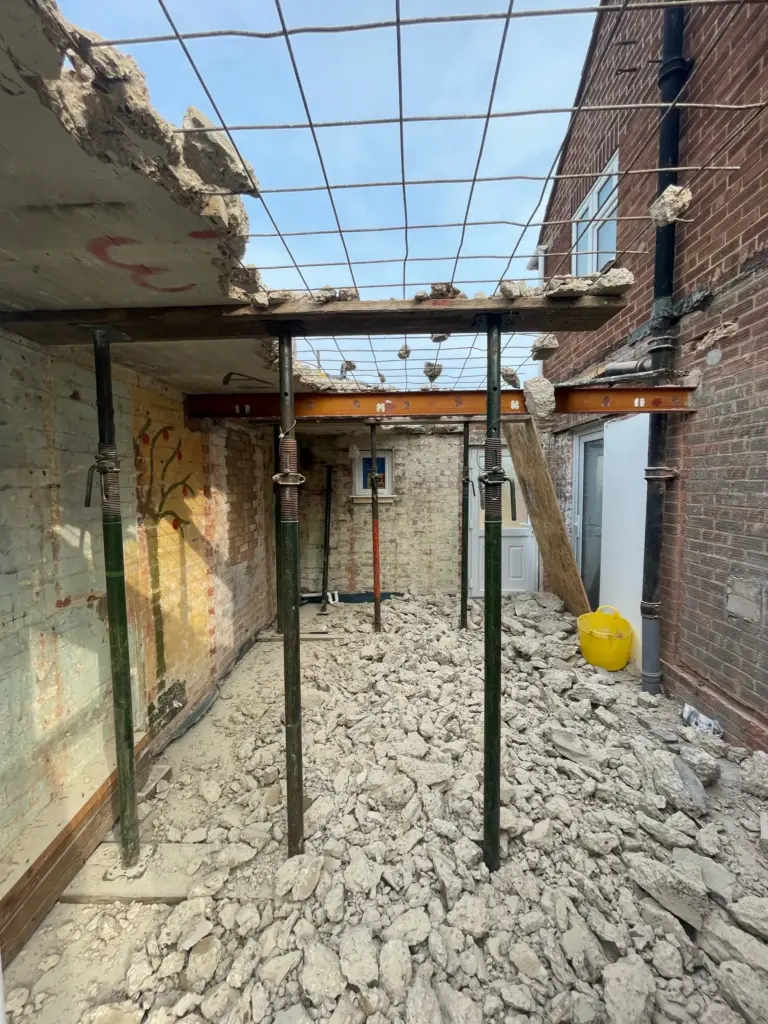
A skip will likely be one of the first things to arrive, along with building materials, scaffolding components, and potentially a small digger. Your garden will start to look like a building site, which, of course, it now is.
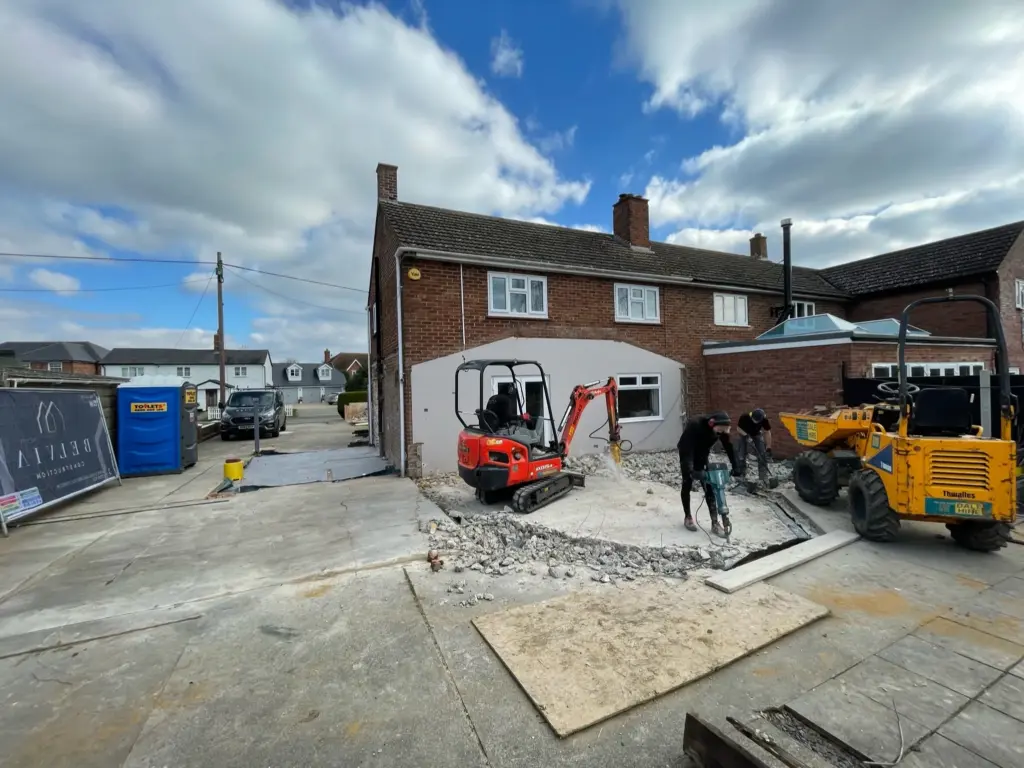
Insider tip: This is when we discuss the practical details of living through a build. Where will deliveries be unloaded? Which route will the team use? Where can materials be safely stored? Clear communication now prevents frustrations later.
Stage 2: Groundworks and Foundations
Timeline: Weeks 1-3 What’s happening: Creating the structural base that will support your extension
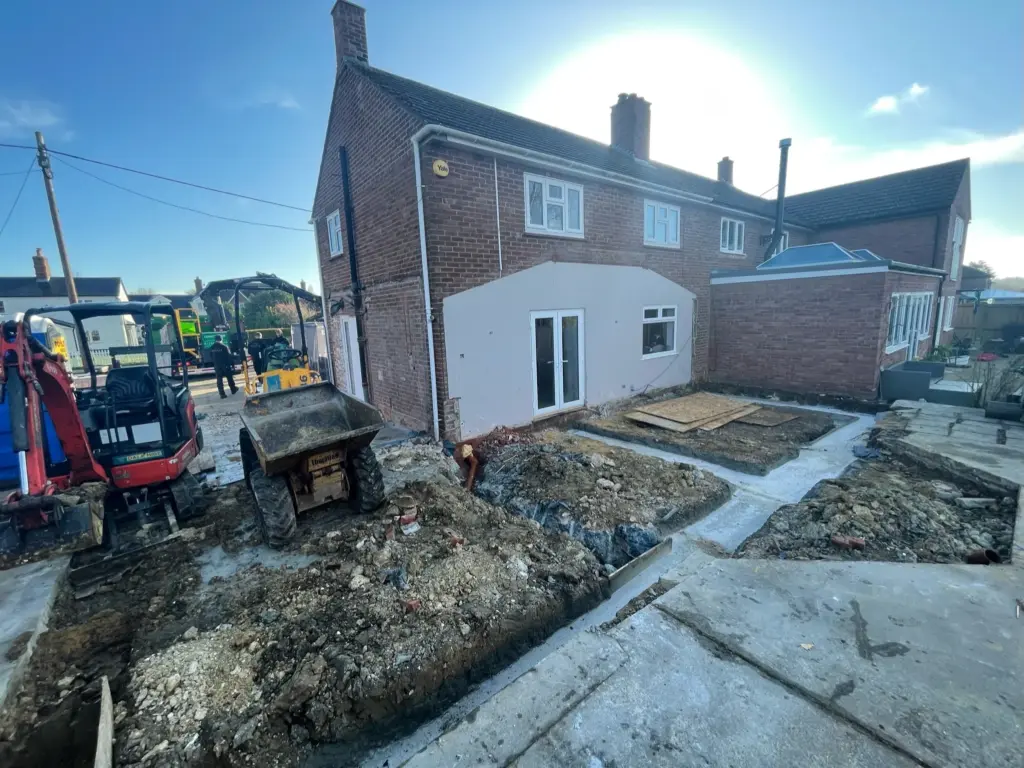
Groundworks are where your extension begins to take physical shape. This phase includes excavating and pouring the foundations, installing drainage, and building up to damp-proof course level.
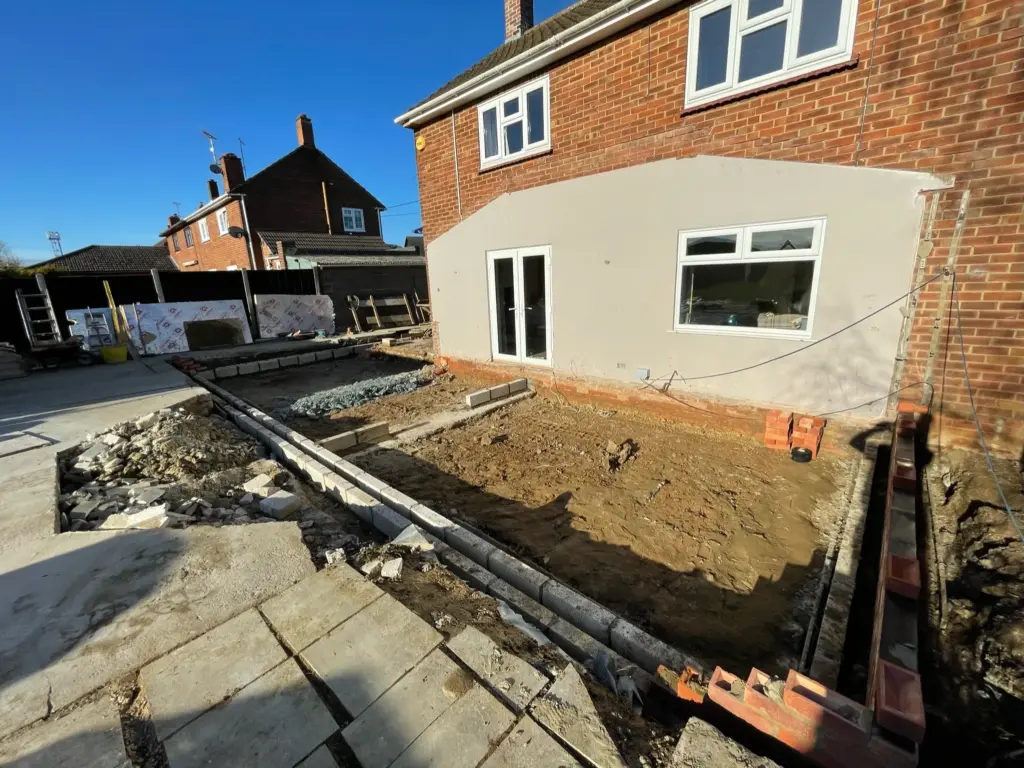
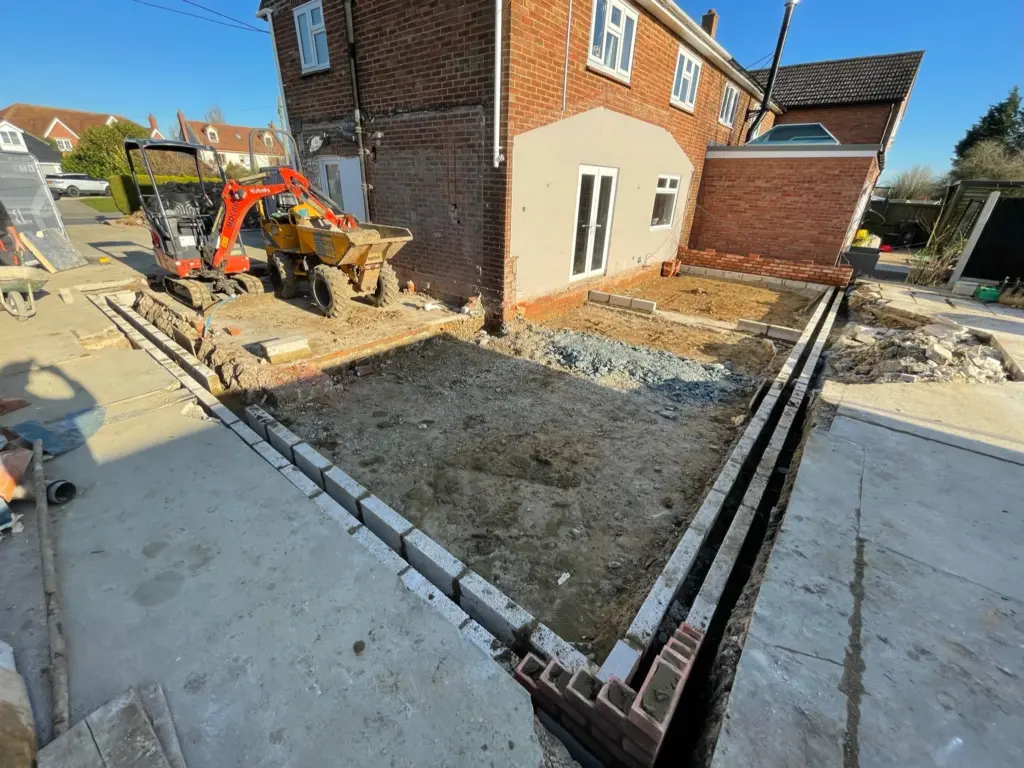
What hapens during this stage?
- Foundation excavation – Trenches are dug according to the structural engineer’s specifications
- Building Control inspection – The inspector checks the trenches before concrete is poured
- Concrete foundations poured – Ready-mix concrete fills the trenches, creating a solid base
- Drainage works – Both foul drainage (from toilets and sinks) and rainwater drainage (from gutters) are installed
- Brickwork to DPC – Blockwork is built up from the foundations to damp-proof course level
- Subfloor construction – Either a concrete slab or beam-and-block floor is installed
What you’ll see:
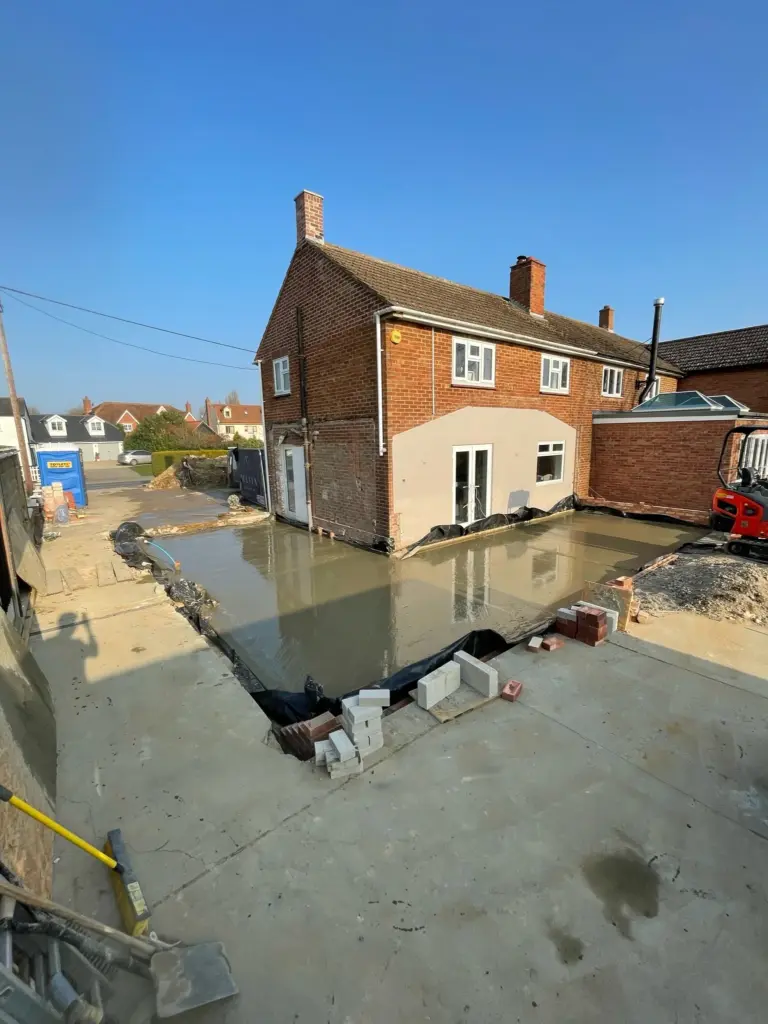
Trenches appearing in your garden, concrete lorries arriving, drainage pipes being laid, and the first courses of blockwork emerging from the ground. By the end of this phase, you’ll see the footprint of your extension marked out in low-level blockwork.
Key terms explained:
- DPC (Damp-Proof Course): A waterproof layer (typically a thick plastic membrane) built into the walls at low level (about 150mm above ground). This prevents moisture from the ground rising up into your walls.
- Trench fill foundations: The most common type for extensions. Trenches are dug and filled almost to the top with concrete, with just a few courses of blockwork above ground level.
- Foul vs rainwater drainage: Foul drainage handles wastewater from toilets, sinks, and appliances. Rainwater drainage handles water from gutters and downpipes. They’re kept separate and connect to different parts of the drainage system.
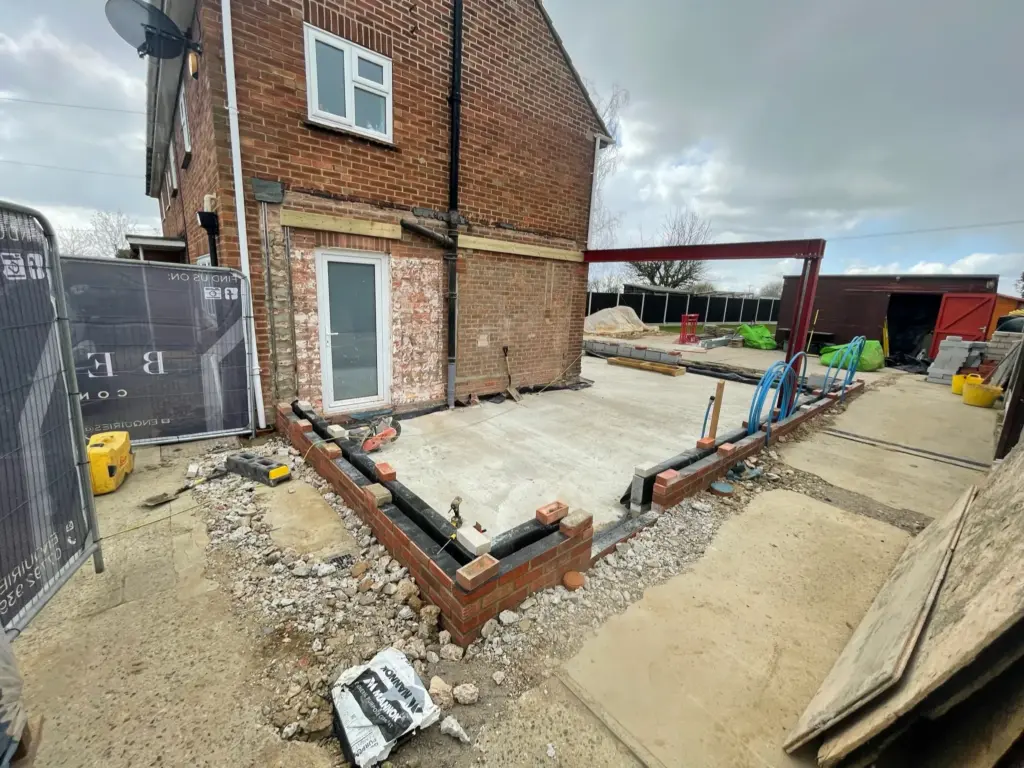
Building Control: The first inspection typically happens at foundation stage. The Building Control officer will check the trench depths, concrete specification, and that everything matches the approved plans before allowing work to continue.
Insider tip: Groundworks are heavily weather-dependent. Heavy rain can flood trenches, and concrete shouldn’t be poured in freezing conditions. This is one reason why spring and summer builds often progress more smoothly. If rain is forecast, we may pause excavation until the weather improves.
Stage 3: Brickwork and Blockwork
Timeline: Weeks 3-5 What’s happening: Building the walls of your extension
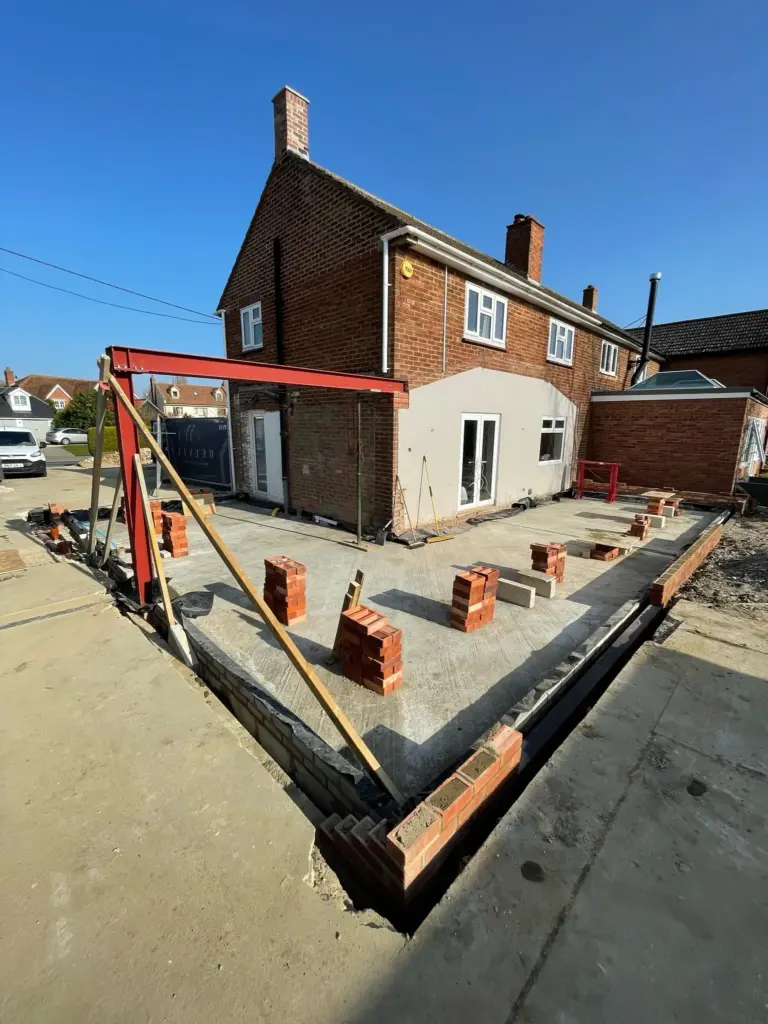
With the foundations complete, your extension starts to rise. This is one of the most visibly satisfying phases, you’ll see real progress every day as the walls grow higher.
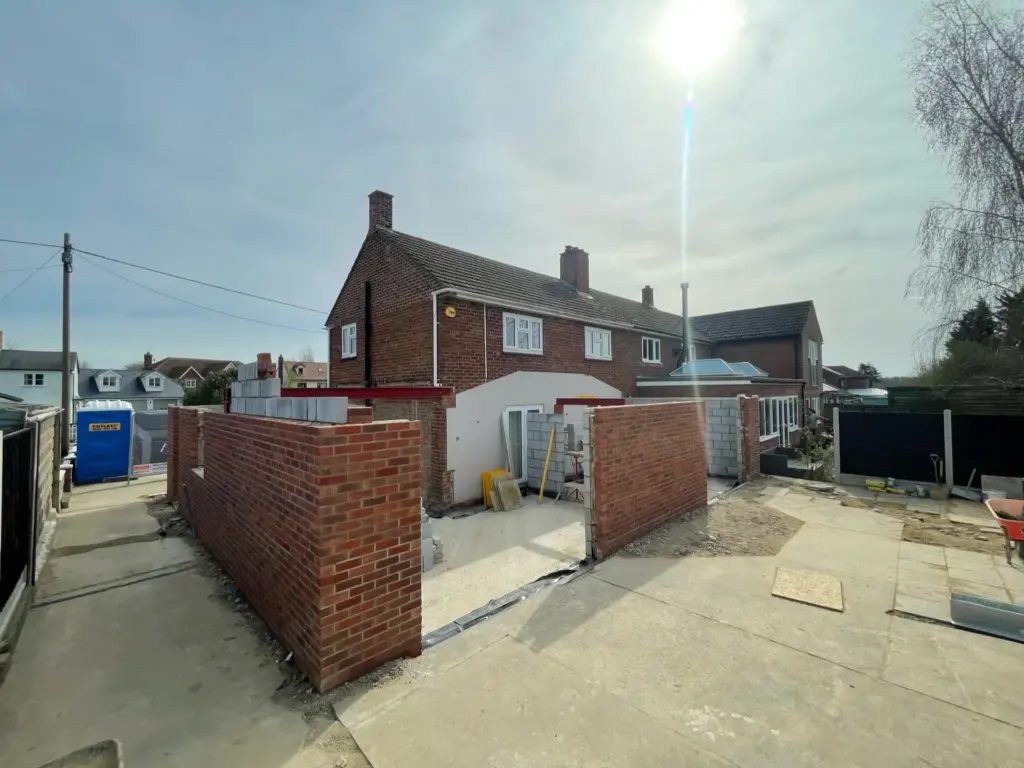
What happens during this stage:
- External walls built – Brick or blockwork rises course by course to joist height and then roof height
- Cavity wall insulation – Insulation boards or batts are fitted in the cavity between the inner and outer walls
- Lintels installed – Structural steel or concrete beams are placed above all window and door openings
- Wall ties fitted – Metal connectors link the inner and outer walls together for structural stability
- Integration with existing house – The new walls are tied into your existing property
What you’ll see:
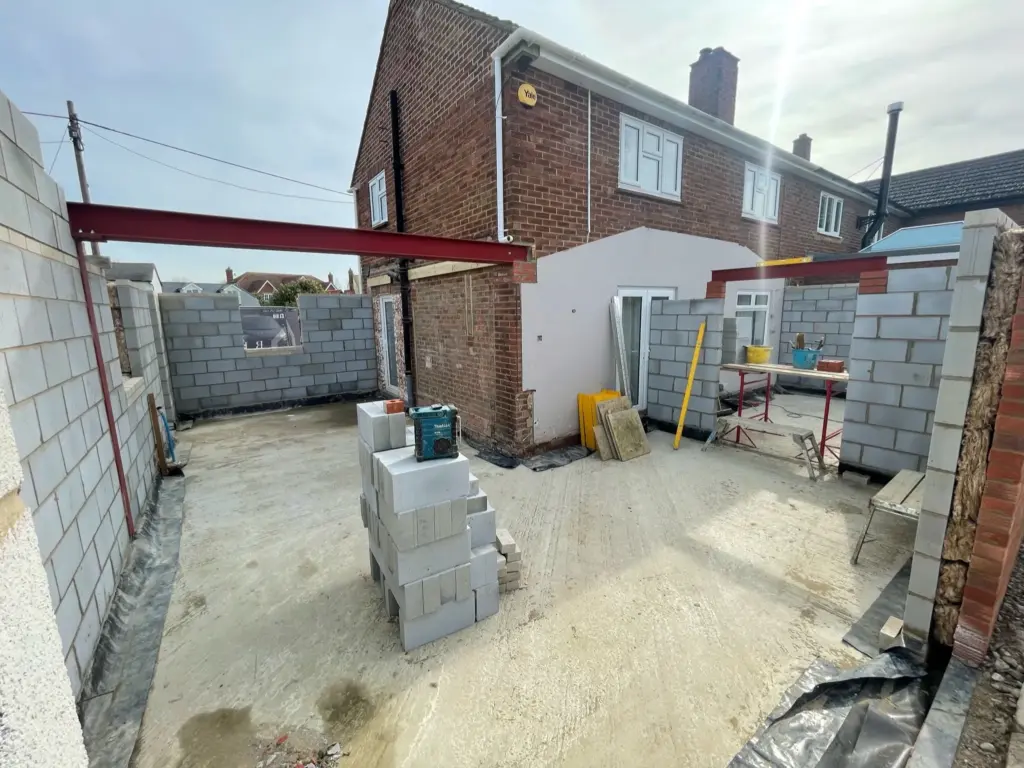
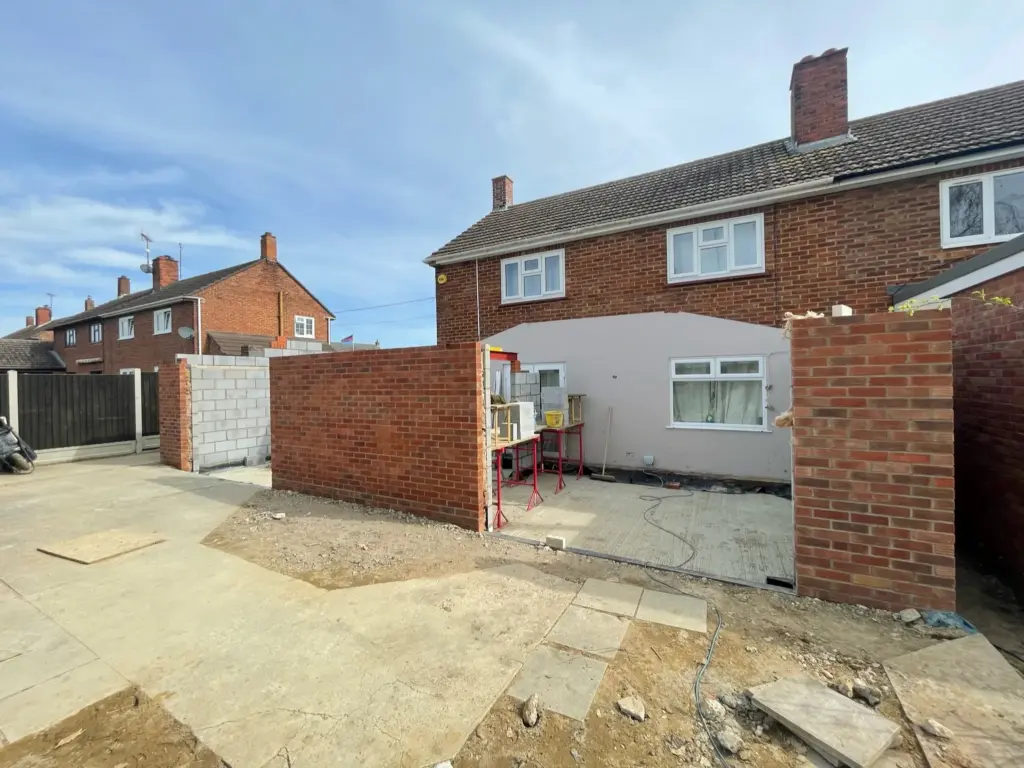
Scaffolding going up, bricks and blocks being delivered, and walls rising steadily. Window and door openings will be clearly visible, with lintels spanning above them. You’ll also see cavity insulation batts visible between the inner and outer walls.
Key Terms Explained:
- Lintel: A structural beam that sits above window and door openings, supporting the weight of the wall above. Steel lintels are most common in modern construction.
- Cavity wall: Modern extensions use two parallel walls—an outer leaf (usually brick) and an inner leaf (usually block)—with an insulated gap between them. This provides excellent thermal performance and weather protection.
- Wall ties: Metal connectors that hold the two leaves of a cavity wall together while allowing for slight movement. They’re built in as the walls rise.
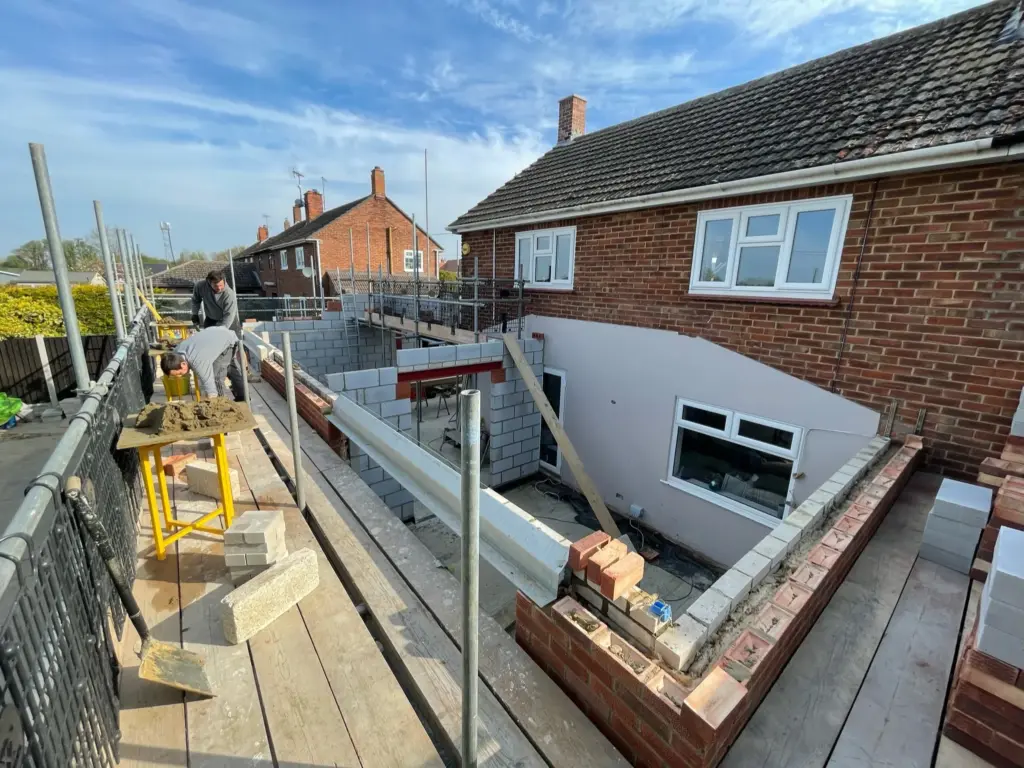
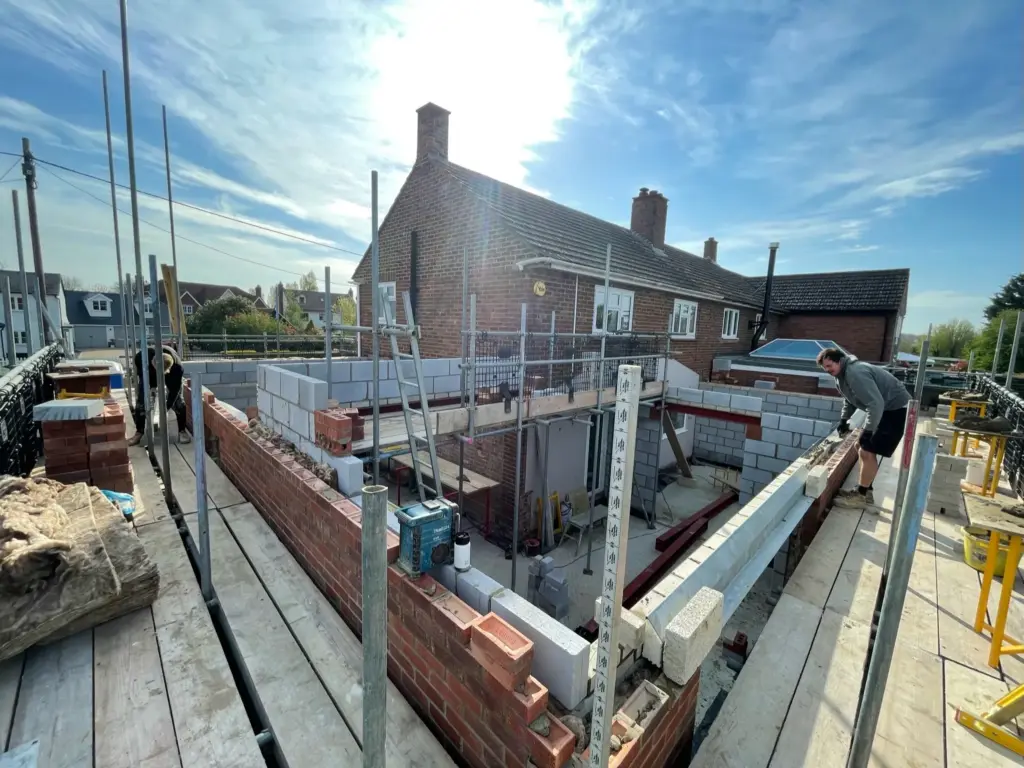
Insider Tip: Good bricklayers work at a steady, consistent pace. You won’t see dramatic changes hour by hour, but day by day the walls will rise noticeably. On a productive day, a skilled bricklayer can lay 400-500 bricks—which translates to several courses of visible progress.
Stage 4: Structural Carpentry
Timeline: Weeks 5-7 What’s happening: Building the timber framework for floors, roof, and internal structure
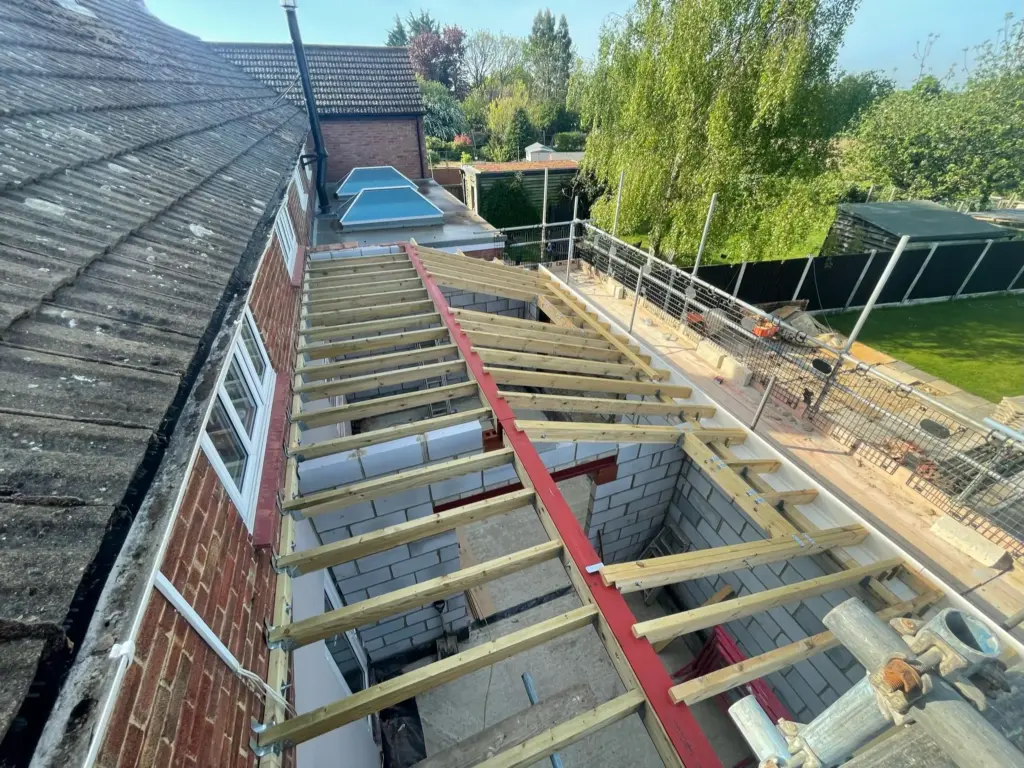
Once the walls reach the required height, the carpenters take over. This is when your extension starts to look like a real building, with a recognisable roof structure taking shape.
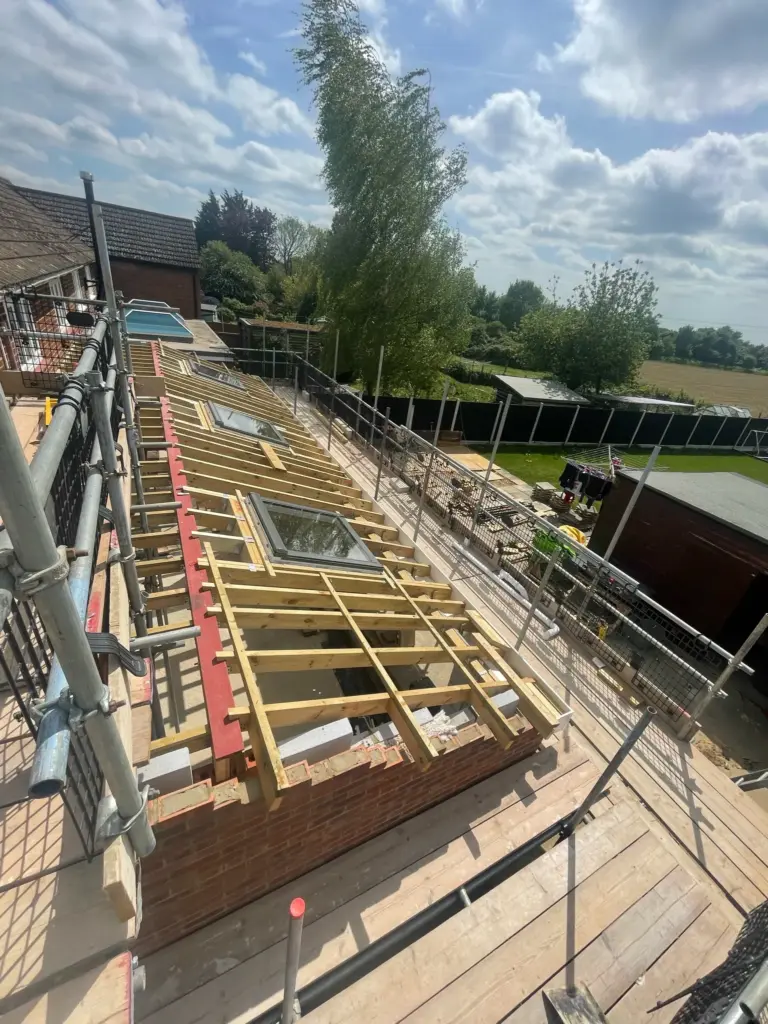
What happens during this stage:
- Floor joists installed – For upper floors (on double-storey extensions) or to span over the ground floor
- Roof timbers cut and fitted – Rafters, ridge boards, and supporting timbers create the roof structure
- Structural floor boarding – Chipboard or plywood sheets laid over joists to create solid floors
- Timber framing and studwork – Internal partition walls are framed out
- Fascias and soffits fitted – The timber boards around the edge of the roof that support guttering and finish the eaves
What you’ll see:
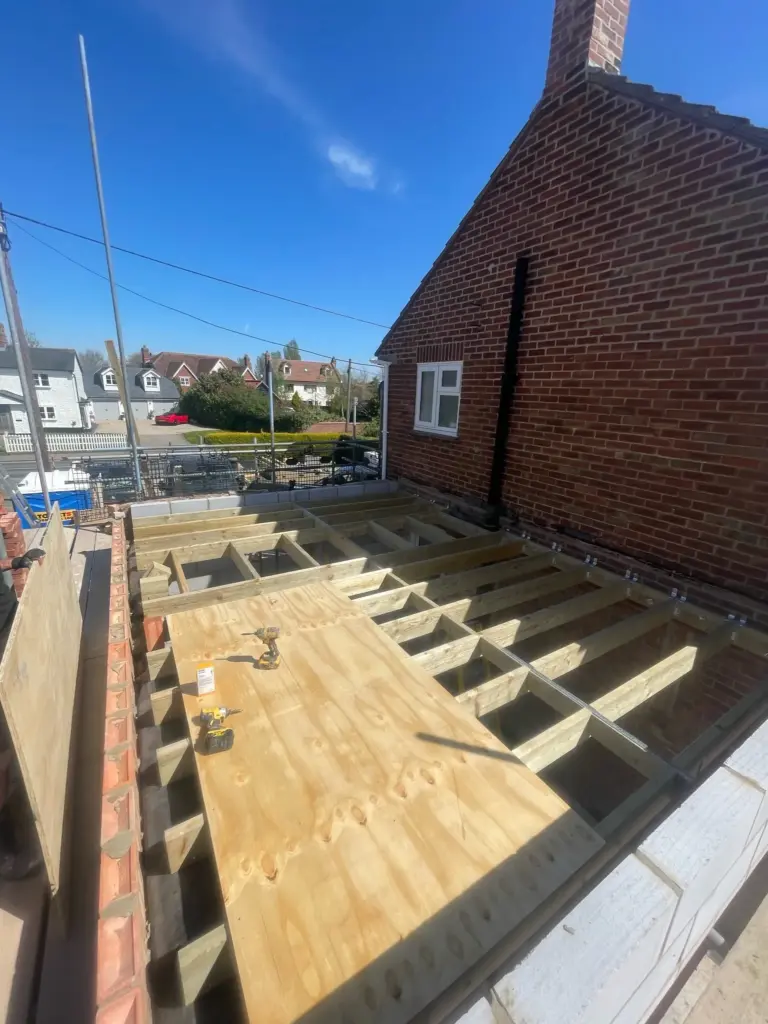
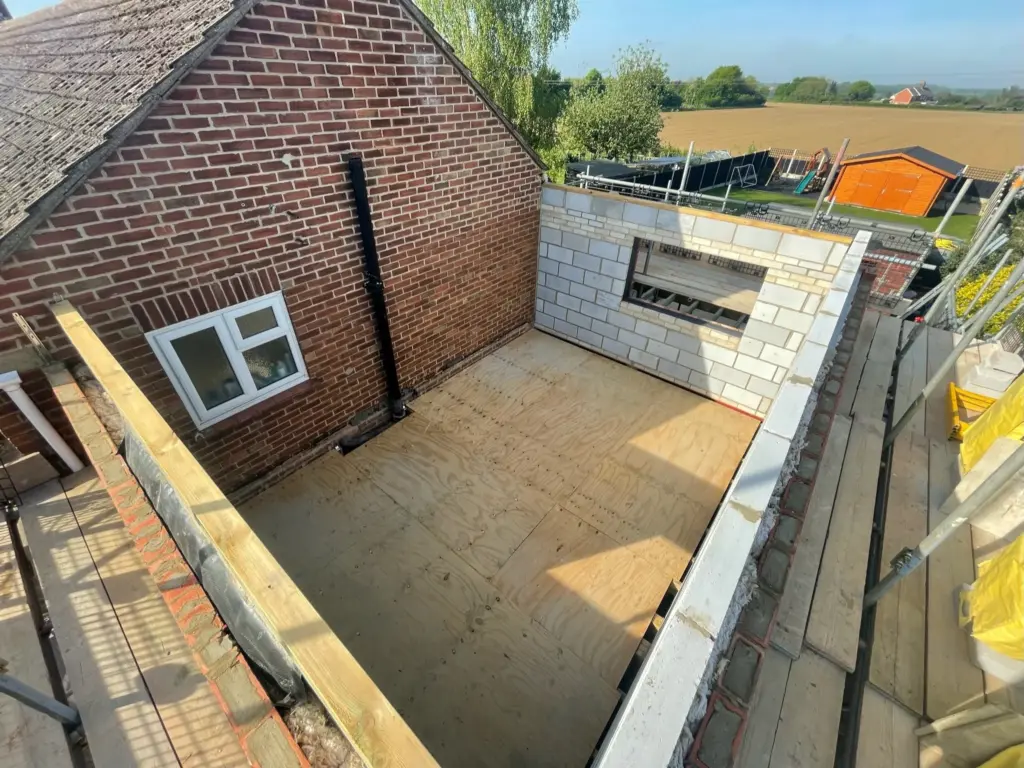
Timber delivered to site in large quantities. Carpenters measuring, cutting, and fitting. The roof structure appearing seemingly quickly, often within a few days, you’ll go from walls to a recognisable roof shape. This is one of the most dramatic transformations in the whole build.
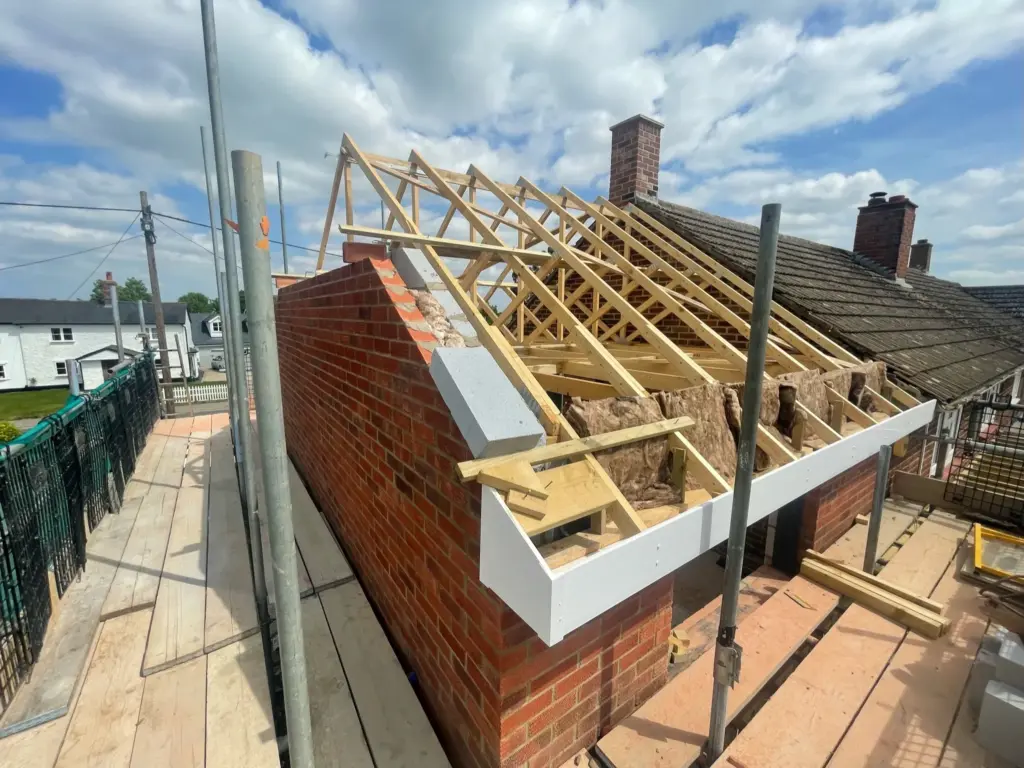
Insider Tip: “This is one of the most exciting stages for homeowners. After weeks of groundworks and slowly-rising walls, suddenly there’s a roof structure and it actually looks like an extension. The carpenters work quickly and efficiently, so you’ll see dramatic changes day to day.”
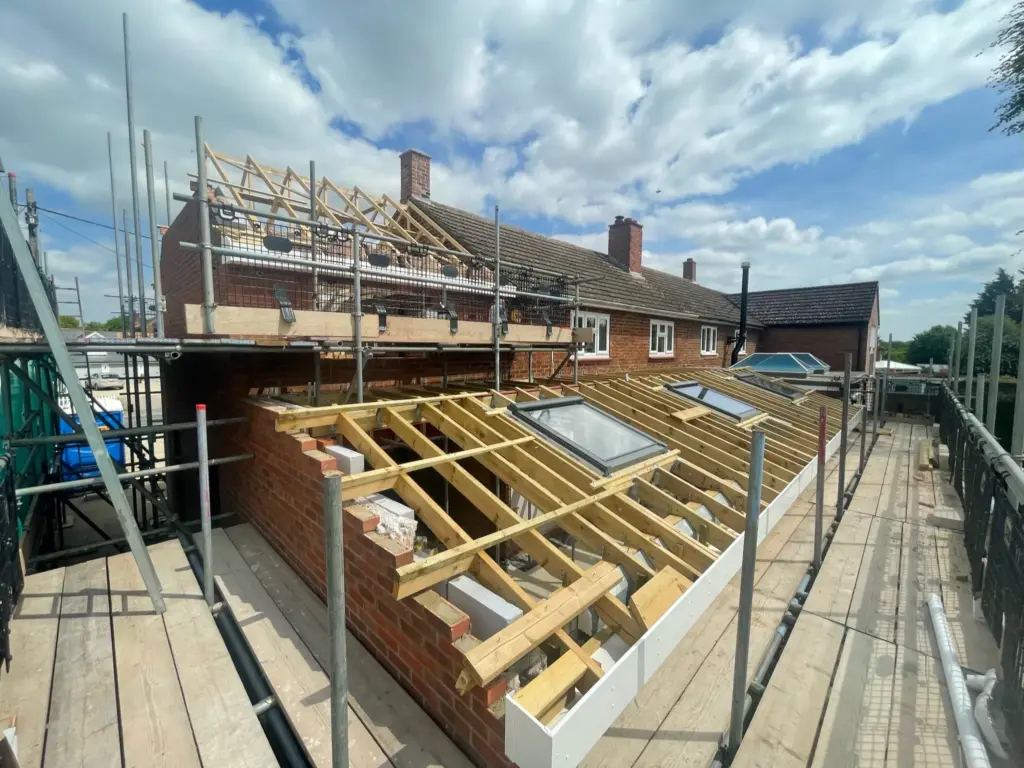
Stage 5: Roof Coverings
Timeline: Weeks 6-8 What’s happening: Making the roof weatherproof
With the roof structure in place, the priority is getting it covered and watertight as quickly as possible. This protects the structure and allows interior work to proceed regardless of weather.
What happens during this stage:
- Breathable membrane (felt) laid – A waterproof but breathable layer is fixed over the rafters
- Roof battens fitted – Horizontal timber strips are nailed to the rafters, providing fixing points for tiles
- Roof tiles or slates installed – Working from the bottom up, tiles are hung on the battens
- Lead work completed – Flashings around edges, junctions, and where the new roof meets the existing house
- Guttering and downpipes fitted – Rainwater goods are installed to direct water away from the building
What you’ll see:
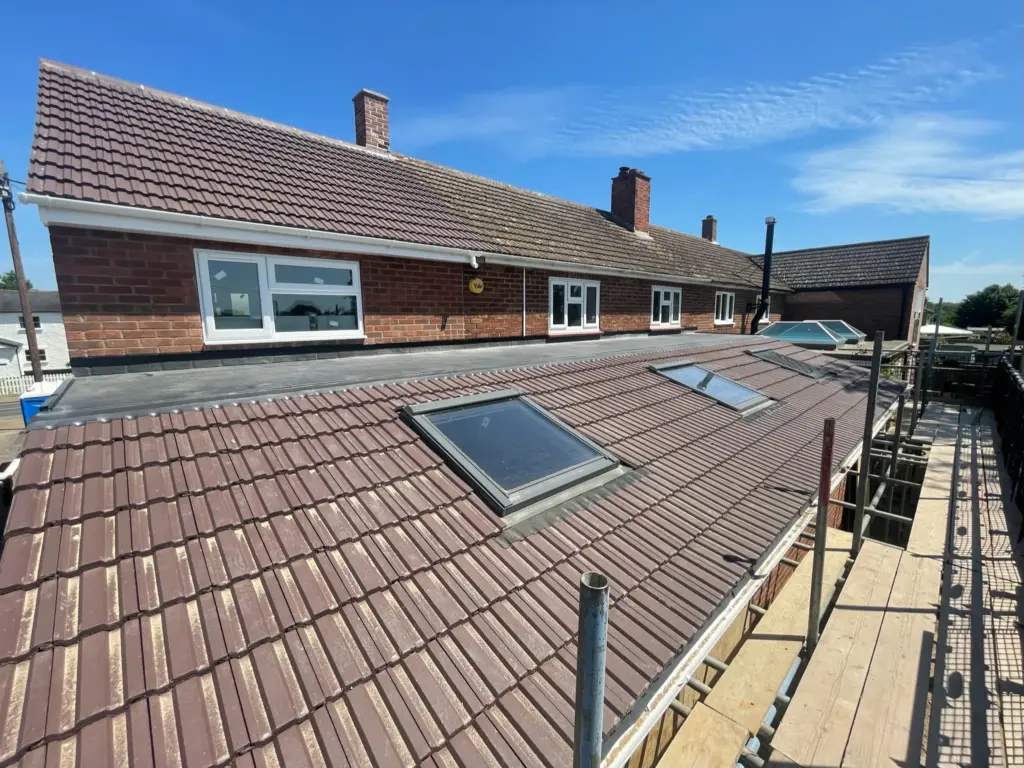
Roofing felt appearing first, then rows of battens, then tiles going on from the eaves upward. Lead work being dressed into place around the edges. Gutters and downpipes completing the exterior.
Key milestone – Watertight: Once the roof is complete, your extension reaches a critical milestone: it’s “watertight.” This means the structure is sealed against the elements, and interior work can proceed regardless of rain or wind outside.
Insider tip: “We prioritise getting to watertight as quickly as possible. Once that’s achieved, we have complete control over the interior schedule. Rain might be hammering down outside, but inside, the plasterers or electricians can carry on working. It’s a game-changer for keeping projects on track.”
Stage 6: Windows, Doors and Making Watertight
Timeline: Weeks 7-8 What’s happening: Installing glazing and completing the external envelope
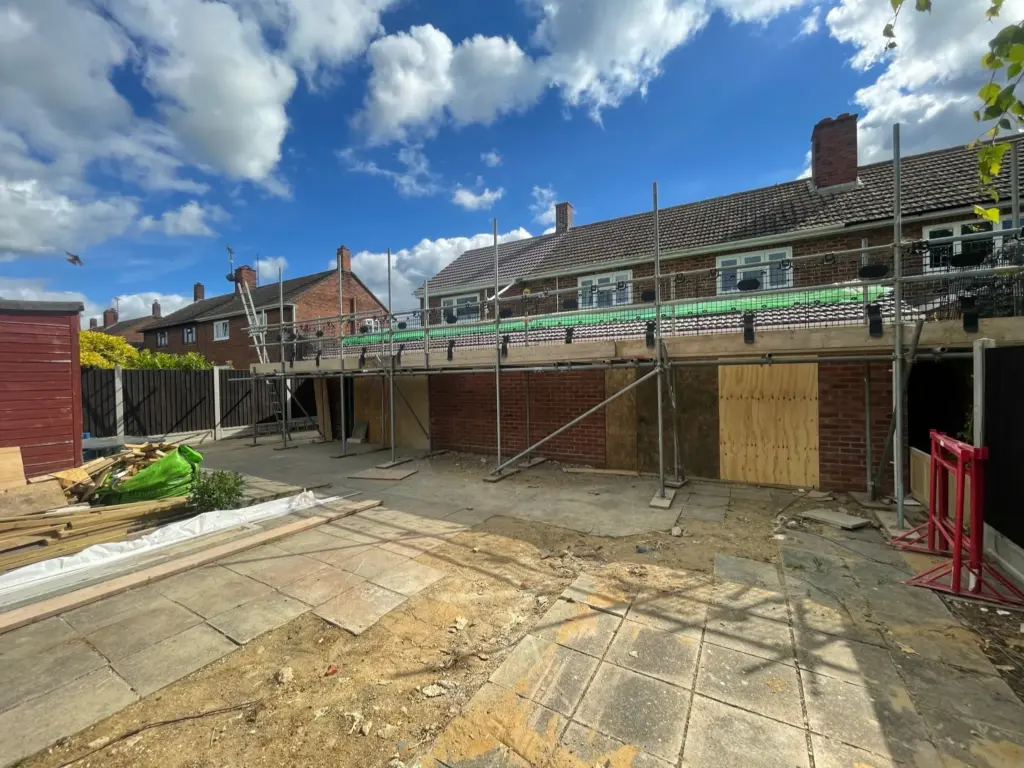
With the roof on, windows and external doors are fitted to fully enclose the structure. This completes the external envelope and marks the transition to interior works.
What happens during this stage:
- Windows installed – Double or triple-glazed units fitted into prepared openings
- External doors fitted – Bi-fold doors, French doors, or standard doors installed
- Sealing and weatherproofing – All joints sealed against weather
- External finishing – Any remaining external brickwork, pointing, or rendering completed
What you’ll see:
Window and door deliveries arriving. Glazing units being lifted into position. Natural light flooding into the space for the first time. The extension now looks complete from the outside.
Why this matters: The combination of completed roof and fitted glazing means your extension is now fully weatherproof. The interior environment is controlled, and trades can work efficiently without weather interruptions.
Stage 7: First Fix
Timeline: Weeks 8-10 What’s happening: Installing all the hidden infrastructure before plastering
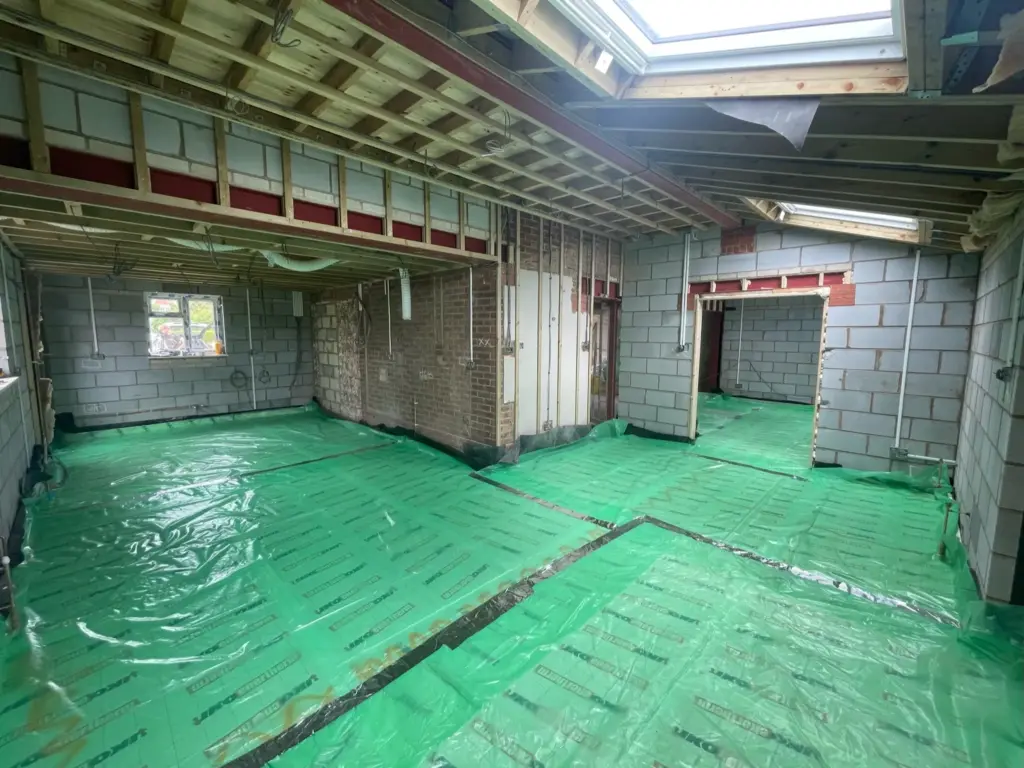
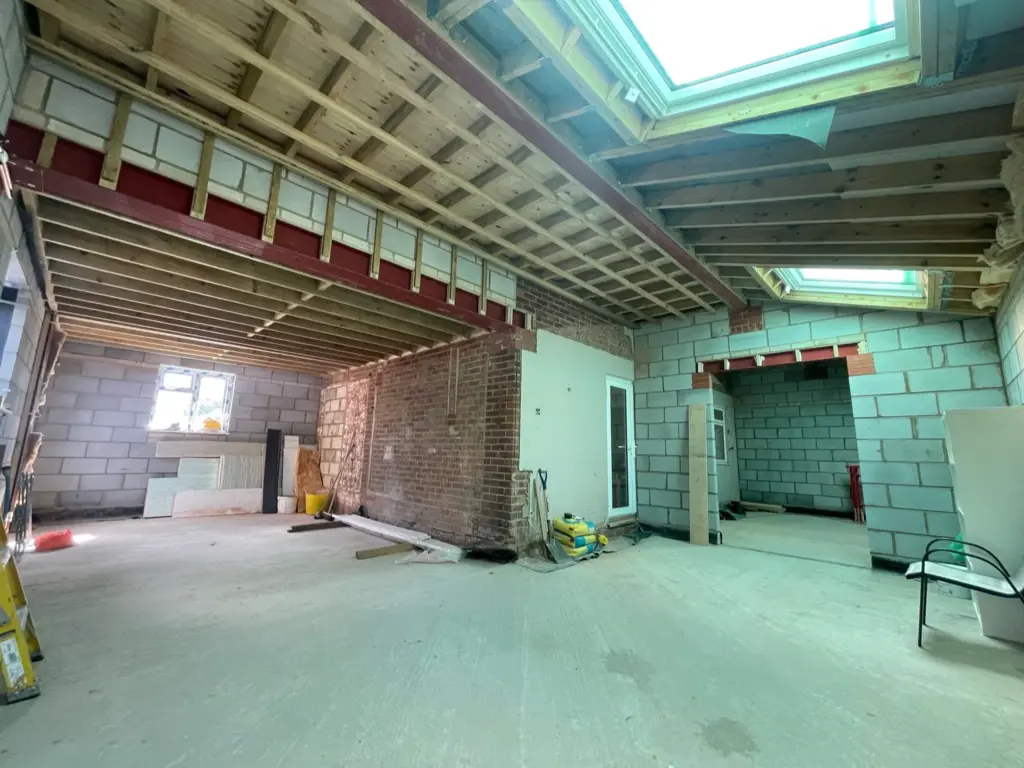
“First fix” is a construction term that covers everything hidden behind your finished walls – the cables, pipes, and framework that make everything else work. This is when electricians, plumbers, and carpenters work together to install the infrastructure of your extension.
What happens during this stage:
- First fix electrical – Cables run through walls, ceilings, and floors; back boxes installed for sockets and switches
- First fix plumbing – Hot and cold water pipes, heating pipework, and waste pipes installed
- Floor screed poured – A smooth cement layer over the concrete slab, providing a level surface for floor finishes
- Insulation fitted – Any remaining insulation in walls, floors, or ceilings
- Carpentry continues – Door linings fixed, window boards fitted, stud walls completed
What you’ll see:
Multiple trades working simultaneously. Cables visible in walls before they’re covered. Pipes running through the structure. Insulation material everywhere. The floor being screeded smooth.
Key terms explained:
- First fix: All the “hidden” infrastructure installed before plastering—cables, pipes, and structural elements that will be concealed behind finished surfaces. The electrician, plumber, and carpenter all have “first fix” phases.
- Floor screed: A smooth cement-based layer poured over the concrete slab. It provides a flat, level surface for your final floor covering (tiles, wood, carpet). It needs time to dry, typically several days to a week, before work continues on top.
- Back boxes: The metal or plastic boxes recessed into walls that house the wiring for sockets and switches. The visible faceplates are fitted later (second fix) once plastering is complete.
The “breakthrough”: At some point during first fix (or shortly after plastering), we’ll create the opening between your existing house and the new extension. This is the moment when old and new connect.
The breakthrough is messy, there’s no way around it. Removing a wall or creating an opening generates dust and debris. We’ll seal off the area as much as possible with dust sheets and temporary screens, and typically complete the structural work in a day or two. Steel beams (if required) will be lifted into position, supported by props until the structure stabilises.
Building Control: An inspection typically occurs before plastering to check insulation levels, fire stopping around structural penetrations, and that electrical and plumbing rough-ins meet regulations.
Insider tip: “First fix is when your extension transforms from an empty shell into a building with potential. You can start to see where sockets will be, trace the route of heating pipes, and visualise the finished layout. It’s also when we confirm final positions for everything—so make sure you’ve decided where you want sockets, lights, and radiators before we get to this stage.”
Stage 8: Plastering and Internal Finishes
Timeline: Weeks 10-12 What’s happening: Creating smooth, finished wall and ceiling surfaces
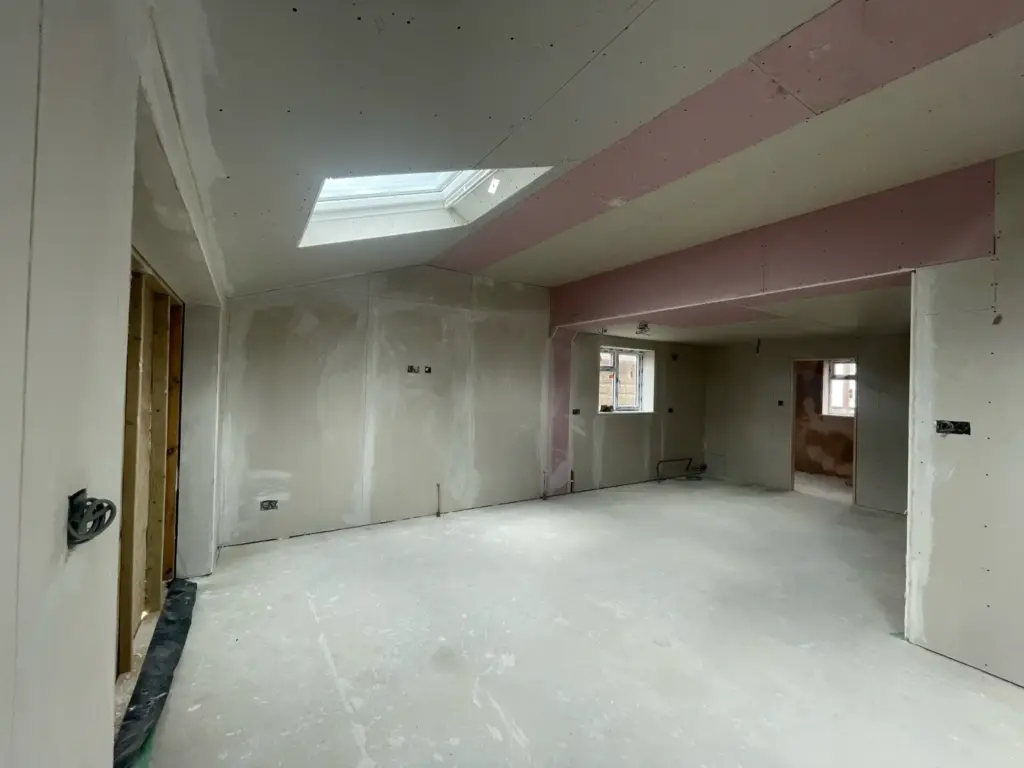
Plastering is transformative. You go from exposed cables and insulation to smooth, clean walls that look like the interior of a finished home.
What happens during this stage:
- Plasterboard fitted – Boards fixed to walls and ceilings, covering all the first fix infrastructure
- Joints taped and filled – The seams between boards are reinforced and smoothed
- Skim coat applied – A thin layer of wet plaster is spread over the boards and smoothed to a perfect finish
- Drying time – The plaster needs to dry completely before decoration (typically 1-2 weeks)
- Making good – Any areas of your existing house affected by the works are repaired and replastered
What you’ll see:
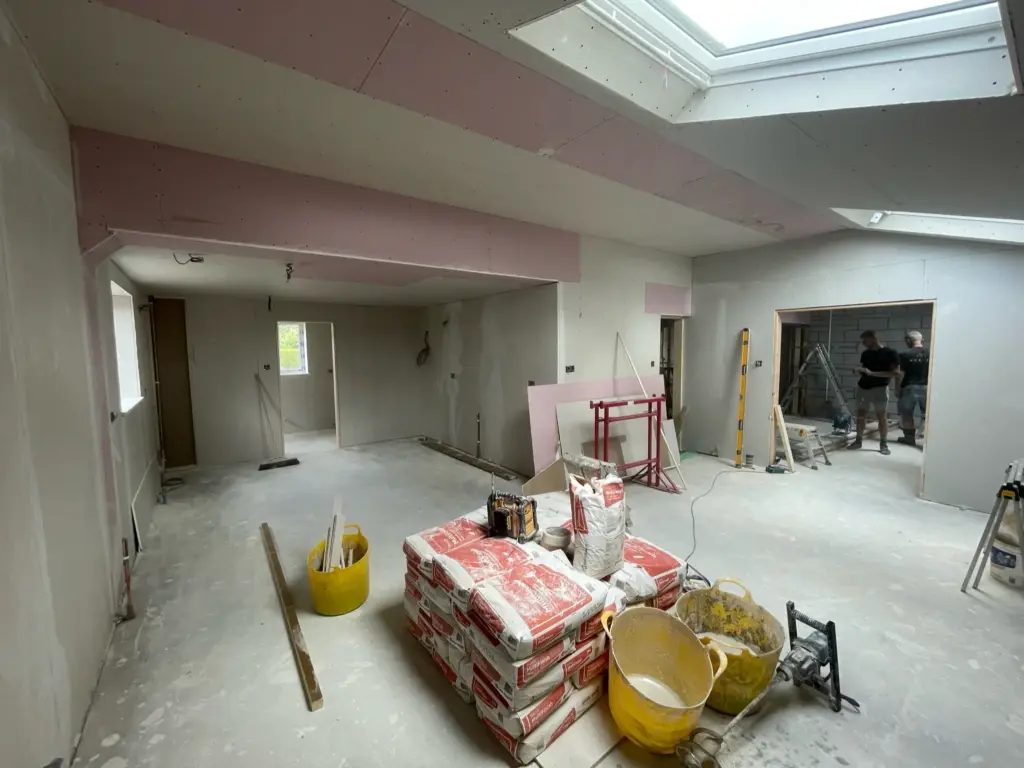
Plasterboards going up quickly. Wet plaster being applied with large trowels. Walls changing colour as they dry—from dark grey when wet to pale pink/cream when dry. Rooms taking their final shape.
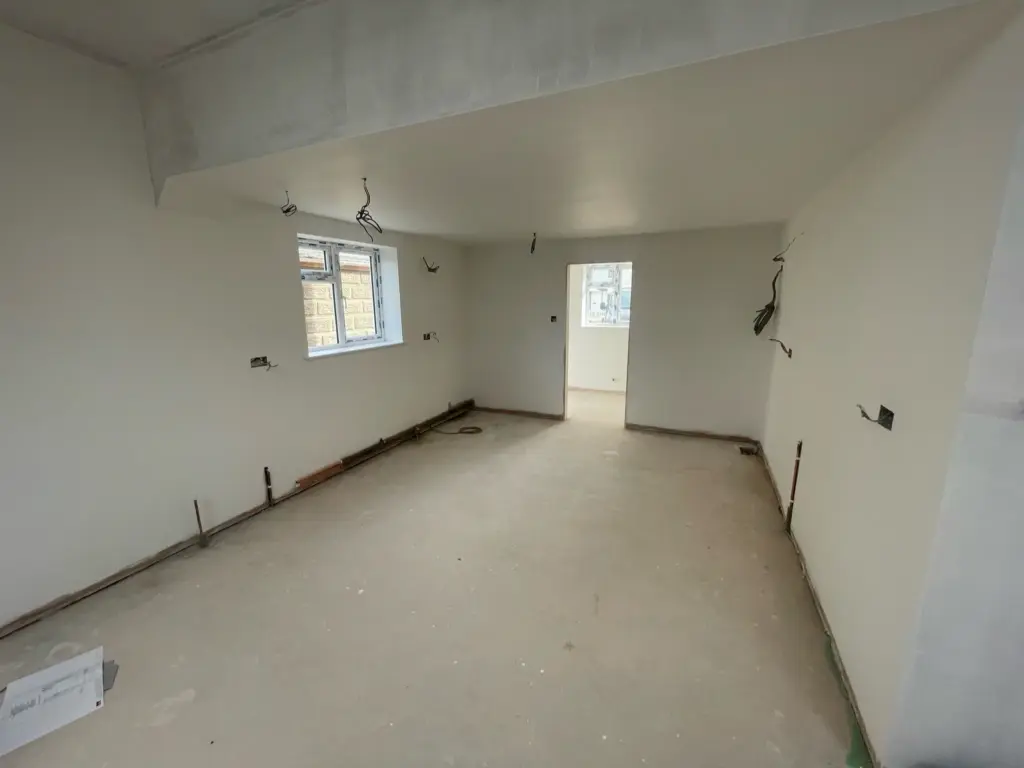
Insider tip: “Plastering transforms the space almost overnight. Suddenly you can see the finished rooms. But, and this is important, fresh plaster needs to dry properly before decoration. Painting onto damp plaster causes peeling and problems. We typically allow at least a week of drying time. If you’re on a tight schedule, heating and ventilation can speed this up, but patience here pays off.”
Stage 9: Second Fix and Installations
Timeline: Weeks 11-13 What’s happening: Fitting all the visible, finished elements
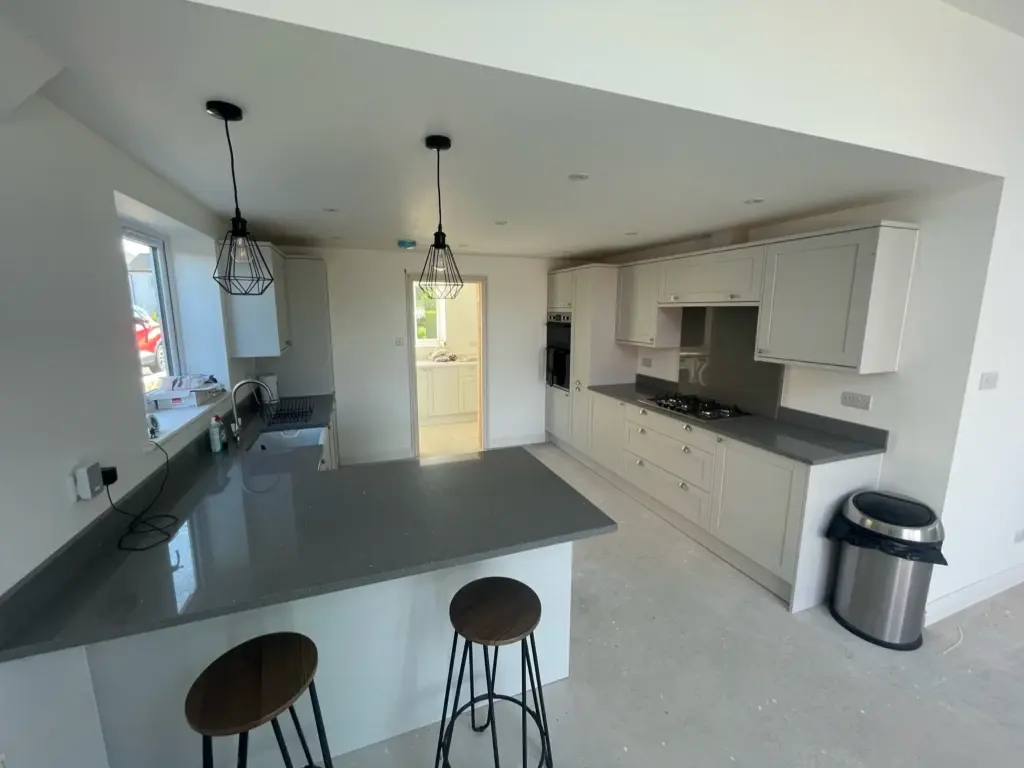
Second fix is when your extension comes to life. All the infrastructure installed during first fix is now connected to visible fittings and finishes. Sockets work. Lights turn on. The kitchen goes in.
What happens during this stage:
- Second fix electrical – Faceplates fitted to sockets and switches, light fittings installed, consumer unit connected and tested
- Second fix plumbing – Sanitaryware fitted (toilets, sinks, taps), radiators hung and connected, boiler adjustments
- Kitchen installation – Units fitted, worktops templated and installed, appliances connected
- Flooring laid – Tiles, hardwood, laminate, or carpet fitted throughout
- Joinery completed – Skirting boards, architraves, internal doors hung, any built-in furniture
What you’ll see:
A flurry of activity with multiple trades working in coordination. Sockets appearing on walls. Kitchen units being assembled and fitted. Flooring going down. Doors being hung. Your extension becoming a usable space.
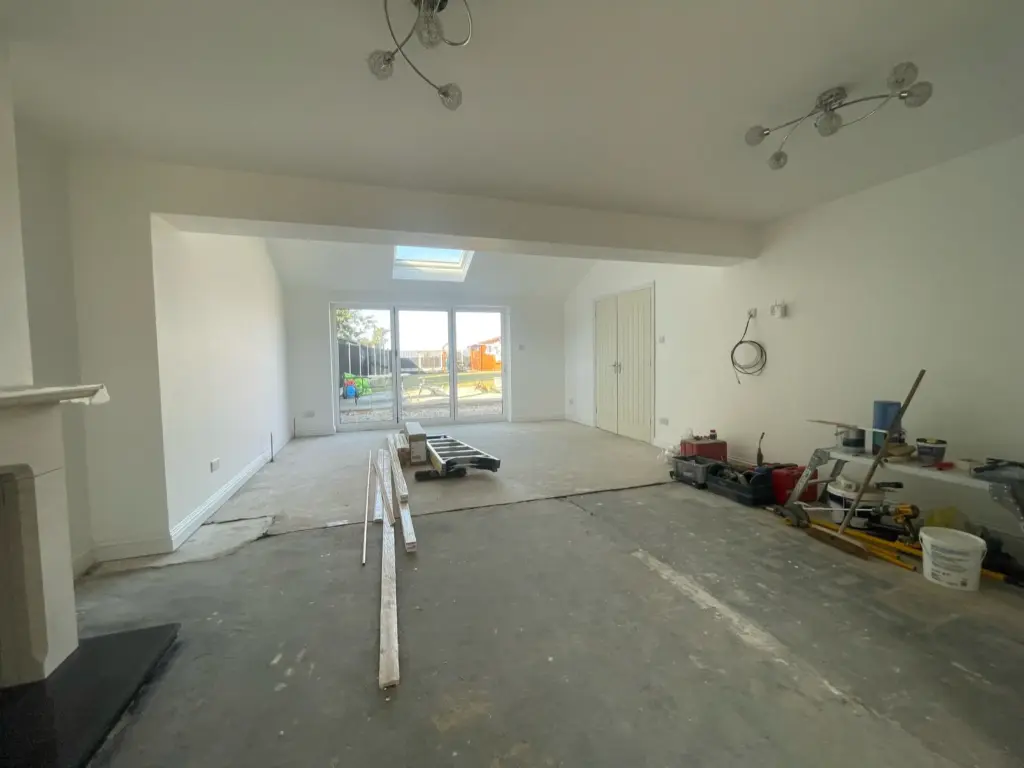
Key terms explained:
- Second fix: All the visible, finished elements that connect to the first fix infrastructure. Sockets, taps, doors, skirting, everything you see and touch in the finished room.
- Architrave: The decorative moulding around door frames where they meet the wall. Along with skirting boards, it provides a clean transition between surfaces.
Insider tip: “Second fix requires careful coordination. The kitchen fitter needs the electrics ready. The electrician needs clear access before flooring goes down. The decorator needs everyone out of the way. This is where good project management really matters. We sequence the trades carefully so everyone has what they need when they need it.”
Stage 10: Snagging, Finals and Handover
Timeline: Week 13-14 What’s happening: Final checks, corrections, and handing over your completed extension
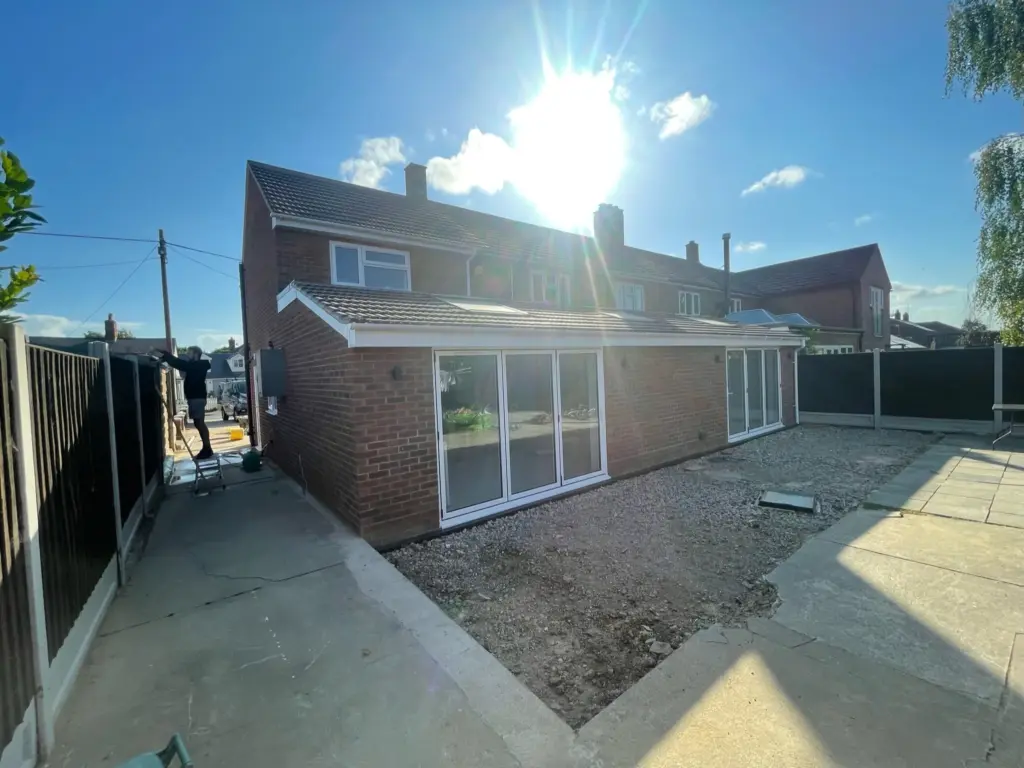
The final stage is about perfection. Snagging involves going through the extension with a fine-tooth comb, identifying any minor issues, and resolving them before handover.
What happens during this stage:
- Decoration completed – Final coats of paint, any wallpapering, finishing touches
- Snagging walk-through – We go through the extension together, noting anything that isn’t quite right
- Corrections made – Any snag items are addressed and rectified
- Final testing – Electrical installation fully tested and certified
- Building Control final inspection – The inspector confirms everything meets regulations
- Site cleared – All equipment, materials, and waste removed
- Handover – You receive your completion certificate and all documentation
What you’ll see:
Painters completing the final touches. The team conducting detailed inspections. Any minor issues being corrected. The site being cleared and cleaned. Your finished extension, ready to use.
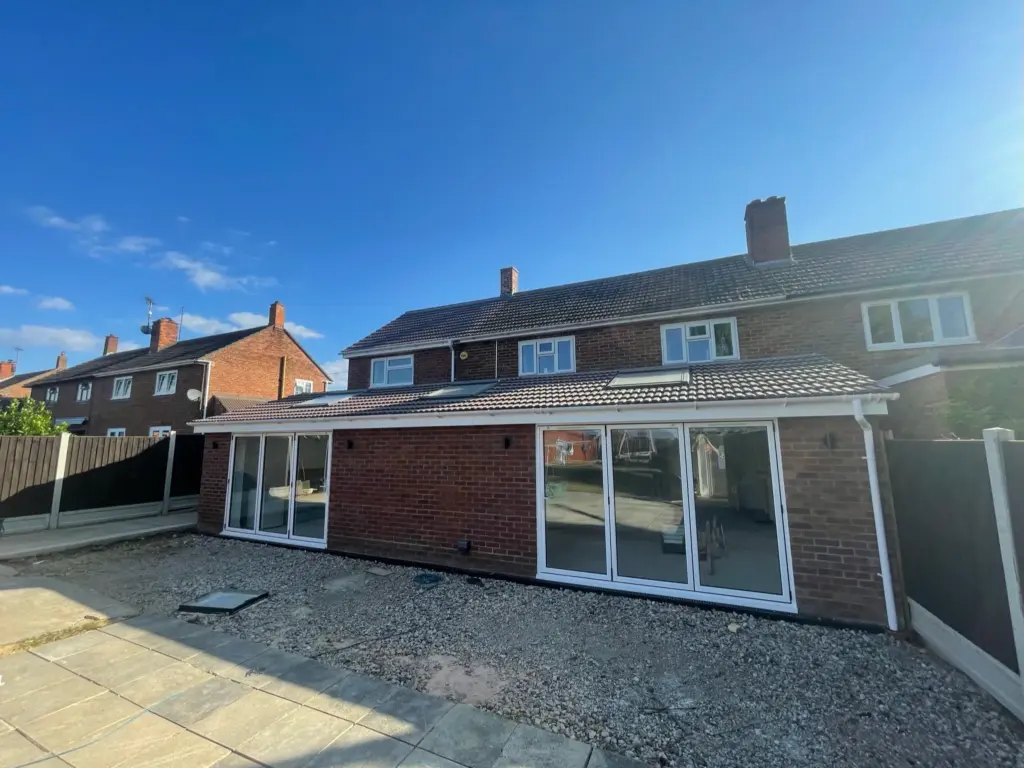
What you receive at handover:
- Building Control completion certificate
- Electrical installation certificate (from qualified electrician)
- Gas Safe certificate (if applicable)
- Window FENSA certificates
- Any warranties and guarantees
- Care and maintenance guidance
- Contact details for any future questions
Insider tip: “Snagging is normal and expected. Even the best builds have a few minor items, a paint touch-up here, a door that needs adjusting there. What matters is how they’re dealt with. We do our own snagging before you do yours, so we catch most things first. Anything you spot, we address promptly. The job isn’t finished until you’re completely satisfied.”
House Extension Timeline: A Visual Summary
Here’s the complete timeline for a typical single-storey rear extension:
PRE-CONSTRUCTION
├── Design & drawings ……………… 2-8 weeks
├── Planning/Building Regs approval …. 2-12 weeks
└── Contractor appointment & lead times. 2-4 weeks
CONSTRUCTION PHASE (10-14 weeks)
│
├── WEEK 1-2: Site Setup & Groundworks
│ └── Equipment arrives, foundations dug, drainage installed
│
├── WEEK 2-3: Foundations Complete
│ └── Concrete poured, subfloor constructed, DPC level reached
│
├── WEEK 3-5: Walls Rise
│ └── Brickwork to roof height, lintels fitted, insulation installed
│
├── WEEK 5-7: Roof Structure
│ └── Carpenters build roof, floor joists, structural framing
│
├── WEEK 6-8: Roof Covering & Glazing
│ └── Tiles on, windows fitted → WATERTIGHT MILESTONE ✓
│
├── WEEK 8-10: First Fix
│ └── Hidden electrics, plumbing, insulation, screed
│
├── WEEK 10-12: Plastering
│ └── Plasterboard, skim coat, drying time
│
├── WEEK 11-13: Second Fix
│ └── Sockets, kitchen, bathroom, flooring, doors
│
└── WEEK 13-14: Snagging & Handover
└── Final checks, Building Control sign-off → COMPLETION ✓
Note: This timeline represents a typical single-storey rear extension of approximately 20-30m². Larger or more complex projects will take proportionally longer at each stage.
What Can Affect Your Extension Timeline?
No two extensions are identical, and several factors can extend or compress your timeline.
Weather
Groundworks, brickwork, and roofing are all weather-sensitive. Heavy rain floods foundation trenches. Frost prevents concrete curing. High winds make roof work dangerous.
Impact: Bad weather during the early stages can add days or weeks to your timeline.
Mitigation: Starting in spring or early summer gives the best chance of favourable conditions during weather-sensitive phases. Once watertight, interior work continues regardless of conditions outside.
Ground Conditions
Essex has varied soil conditions. Clay soil—common across much of the county—expands and contracts with moisture, potentially requiring deeper foundations. Unexpected ground conditions (old drains, filled ground, high water table) can require additional work.
Impact: Poor ground conditions can add time and cost to the foundation stage.
Mitigation: A good builder will assess ground conditions early and factor contingencies into the programme.
Planning and Approvals
Permitted Development projects avoid planning delays, but Building Regulations approval is always required. If you need full planning permission, allow 8-12 weeks for the application process.
Impact: Planning delays push back your start date but don’t affect construction duration.
Mitigation: Submit applications early and ensure they’re complete to avoid requests for additional information.
Party Wall Agreements
If your extension affects a shared wall or is built near a boundary, you’ll need Party Wall agreements with neighbours. Cooperative neighbours can resolve this in weeks; difficult situations can take months.
Impact: Potentially significant delays before construction can begin.
Mitigation: Talk to neighbours early, explain your plans, and address concerns proactively.
Material Lead Times
Windows, structural steel, kitchens, and specialist items all have lead times. Poor planning means waiting for deliveries; good planning means materials arrive exactly when needed.
Impact: Waiting for materials can pause entire stages of the build.
Your builder will manage structural material orders and scheduling. For items you’re supplying yourself (kitchens, tiles, sanitary goods), ask your builder for guidance on when to order so nothing holds up progress.
Design Changes
Changing your mind during construction—moving a socket, changing the kitchen layout, adding a window—creates delays. Every change needs reassessment, potentially new materials, and disrupts the planned workflow.
Impact: Changes during construction almost always add time and cost.
Mitigation: Finalise all decisions before construction begins. If you must change something, do it as early as possible.
Access and Site Constraints
Terraced houses with no side access require materials to be carried through the house. Narrow streets complicate deliveries. Limited space means less room for material storage.
Impact: Difficult access slows every stage of the build.
Mitigation: Discuss access constraints with your builder before work begins so they can plan accordingly.
Tips for a Smooth Extension Build
Before Construction Begins
Finalise all decisions early. Choose your window styles, door handles, socket positions, tile colours, and kitchen layout before work starts. Decisions made on site under pressure are often regretted.
Order long-lead items. Your builder will handle ordering structural materials, windows, and roof lights as part of the build programme. But you may need to order your own kitchen units, worktops, sanitary goods, and tiles. Your builder will advise you on the right time to place these orders so everything arrives on schedule..
Discuss the practicalities. Where will materials be stored? Which route will the team use? Where can they park? What time will they arrive? Clear agreements prevent daily frustrations.
Inform your neighbours. Even if you don’t need a Party Wall agreement, let neighbours know about the work. A courtesy heads-up about timings and potential noise goes a long way.
During Construction
Maintain communication. Your project manager should provide regular updates, but don’t hesitate to ask questions if you’re unsure about anything. Good communication prevents misunderstandings.
Make decisions promptly. When asked to approve something or make a choice, respond quickly. Delayed decisions delay the build.
Stay flexible. Construction rarely goes exactly to plan. Minor adjustments are normal. Focus on the end result rather than day-to-day variations.
Keep access clear. Deliveries will arrive throughout the build. Ensure there’s a clear route for materials and that parking is available when needed.
Living Through a Build
Most homeowners stay in their home during an extension. Here’s how to manage it:
Plan for disruption. The breakthrough phase (when old and new are connected) is the most disruptive. Dust will spread despite precautions so it’s important to plan accordingly.
Consider a temporary kitchen. If your kitchen is being extended or replaced, you’ll be without it for 3-4 weeks. A microwave, kettle, and toaster in another room, plus a temporary fridge, makes life bearable.
Expect noise. Power tools, radio, and general building activity mean daytime noise is inevitable. If you work from home, plan for meetings elsewhere during noisy phases.
Be patient. The messy middle stages can be dispiriting. The breakthrough phase, with dust sheets everywhere and your house open to the elements, is challenging. Remember: it’s temporary, and the result will be worth it.
House Extension FAQs
How long does a single-storey extension take to build?
The construction phase for a single-storey rear extension typically takes 10-14 weeks. Including design, approvals, and preparation, expect a total project time of 4-6 months from initial consultation to completion.
How long does a double-storey extension take?
Double-storey extensions typically take 14-20 weeks to construct, with additional time for design and approvals. Total project time is usually 5-8 months.
What is a first fix and second fix?
First fix includes all the hidden infrastructure installed before plastering; electrical cables, plumbing pipes, and structural elements. Second fix covers all the visible finished items installed after plastering, sockets, taps, doors, skirting boards, and light fittings. Understanding this distinction helps you follow your build’s progress.
What is the best time of year to build an extension?
Spring and summer (April to September) offer the best conditions for groundworks, brickwork, and roofing. However, starting your design work in autumn means you can secure planning approvals over winter and begin construction when the weather improves in spring, often the ideal approach.
Can I live in my house during an extension?
Yes, most homeowners remain in their home throughout. The main disruption occurs when we “break through” into your existing house and during kitchen installation if you’re extending your kitchen. The dusty, noisy periods are relatively brief in the context of the overall project.
When should I order my kitchen for an extension?
Order your kitchen 6-8 weeks before the anticipated installation date. In practice, this usually means placing the order around the time first fix begins, with delivery scheduled for when plastering is complete and the floor screed has dried.
What is DPC in construction?
DPC stands for Damp-Proof Course: A waterproof layer built into walls at low level (typically 150mm above ground) to prevent moisture from the ground rising up into the building. You’ll see the DPC marked on drawings and hear it referenced when brickwork reaches this important level.
When is an extension considered “watertight”?
An extension is watertight once the roof covering is complete, windows and doors are fitted, and the structure is fully sealed against the elements. This is a significant milestone because it means interior work can proceed regardless of weather conditions outside.
Do I need planning permission for a house extension?
In many cases the answer is no. A large number of house extensions in Essex fall under Permitted Development (PD) rights, meaning you can build without submitting a full planning application.
However, this depends entirely on the size, design, and location of your home, and the rules can sometimes feel unnecessarily complicated.
[Read our guide: Do I Need Planning Permission for a House Extension in Essex?]
Ready to Start Your Extension Project?
Every extension project is different, but understanding the build process helps you plan effectively and set realistic expectations. With proper preparation, clear communication, and an experienced builder, your extension can progress smoothly from first dig to final handover.
At Belvia Construction, we’ve guided homeowners across Essex through hundreds of extension projects. We handle everything from initial consultation through to Building Control sign-off, keeping you informed at every stage with clear communication and no surprises.
Ready to discuss your project?
We offer free, no-obligation consultations where we’ll assess your property, discuss your requirements, answer your questions, and provide a detailed quote with realistic timelines.
Related Articles
- Do I Need Planning Permission for a House Extension in Essex?
- House Extension Costs in Essex: Complete Guide
- Kitchen Renovations and Extensions
About This Article
This guide was written by the team at Belvia Construction, drawing on over 20 years of experience building extensions across Essex. The photographs show a real project we completed in Marks Tey, Colchester – no stock images, just honest documentation of how extensions are actually built.
Have a question we haven’t answered? Get in touch – we’re always happy to help.